

Terengganu MP Rosol Wahid recently proposed polygamy as a solution to tackle the issue of an ageing population and declining birth rate.
However, this proposal fails to recognise the social conflicts and family problems that may arise with polygamy.
Wanita MCA strongly opposes the suggestion by Rosol; we need to emphasise that this suggestion overlooks the actual economic and social responsibilities involved. Not only that, it also undermines the nation’s long-term stability and development.
To tackle the issue of an ageing population, the government must instead adopt practical and comprehensive policies, rather than considering unrealistic and absurd suggestions that are detached from our social reality.
While increasing the birth rate can help alleviate an ageing population, expanding the number of children must be based on the premise that families have the economic capacity and time to care for them.
If children cannot receive proper upbringing and education, the quality of the next generation’s development will be significantly affected. This neglect will only lead to more social problems.
It is worthwhile noting that Wanita MCA’s first chairperson, Chow Poh Kheng, called for the enactment of the Law Reform (Marriage and Divorce) Act 1976, successfully advocating for it, and saw to it being officially passed in Parliament on March 1, 1982.
This legislation established the foundation for monogamous marriages for non-Muslims, whilst reassuring the protection and status of non-Muslim women in any legal marriage.
Promoting Birth Rate And Economic Development Through Pragmatic Policies
Moving forward, Wanita MCA proposes that the government should focus on improving economic conditions and enhancing the social environment to assist people in alleviating the burden of child-raising, thereby encouraging citizens to actively increase the birth rate.
Policy suggestions include:
Increase Economic Support: Introduce higher child care allowances and tax incentives to ease the financial burden on families.
Provide child care service subsidies to help young parents balance their careers and family life with peace of mind.
Improve Work-Life Balance: Implement flexible work policies, encourage employers to offer flexible work arrangements for parents, allowing them to balance professional development with family responsibilities.
Enhance Home Ownership and Education Security: Provide more affordable housing to help lower the financial pressures heaved on young adults, thereby enhancing the willingness of married couples to bear children.
Implement a high-quality education system that is either free or low-cost to ensure children grow up in a healthy and quality environment.
Introduce High-Quality Immigration Policies: Attract highly skilled immigrants of a certain financial standing to support the country’s workforce and population base, while boosting the overall economic potential.
Population Policy Must Focus On Quality, Not Quantity
The rakyat’s expectations for life are to pursue high-quality living and family wellbeing, not to sacrifice the future of the next generation in order to grow population numbers.
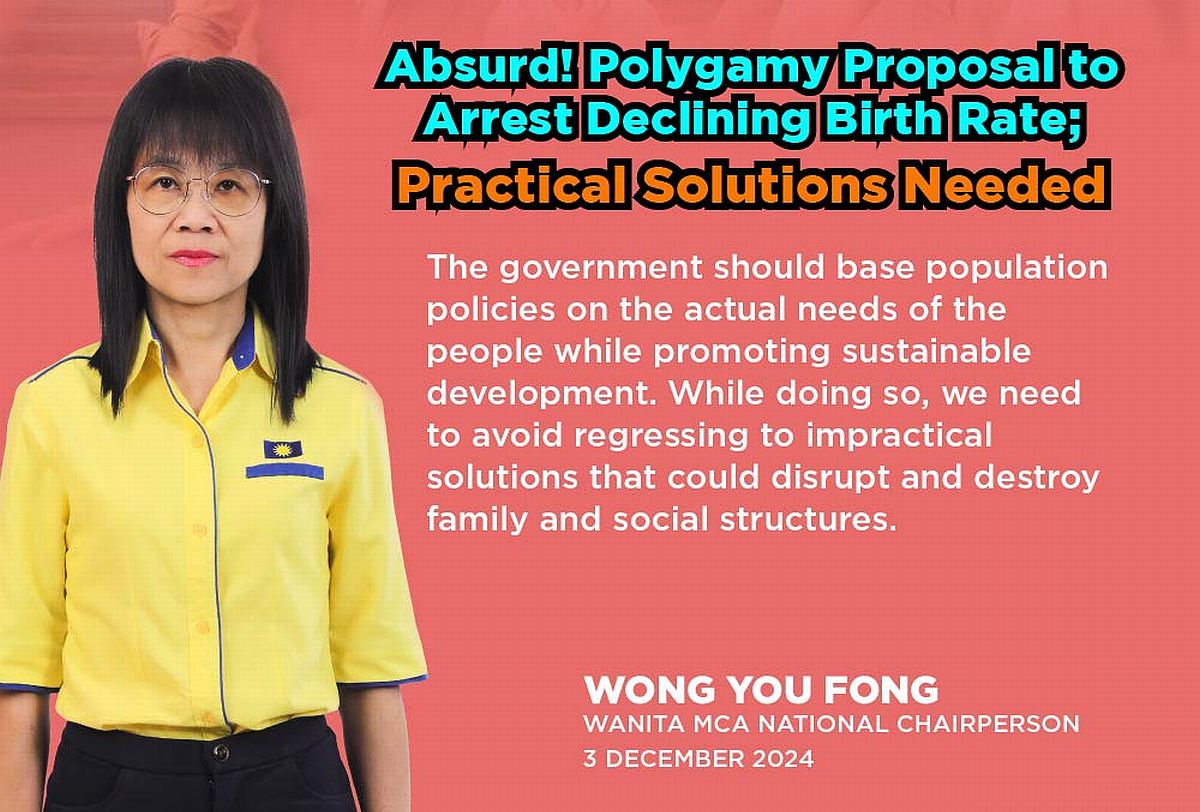
To stress upon this matter again, the government should base population policies on the actual needs of the people while promoting sustainable development. While doing so, we need to avoid regressing to impractical solutions that could disrupt and destroy family and social structures.
Wong You Fong is Wanita MCA national chairperson.
- This is the personal opinion of the writer or publication and does not necessarily represent the views of Ova.