
KUALA LUMPUR, March 25 – A new report examines the barriers that gender based violence (GBV) survivors face in accessing crucial services including medical treatment, police protection, and mental health support, as well as weaknesses in the one stop crisis centre (OSCC) system that prevent effective service delivery.
The findings in the report by the United Nations Population Fund (UNFPA) Malaysia and the United Nations International Institute for Global Health (UNU-IIGH) are derived from a qualitative study conducted with GBV survivors and representatives from CSOs.
Through case studies and in-depth interviews, participants highlighted a number of critical issues that must be addressed to enhance the overall efficacy of GBV services in Malaysia.
Lack Of Awareness About OSCC And GBV

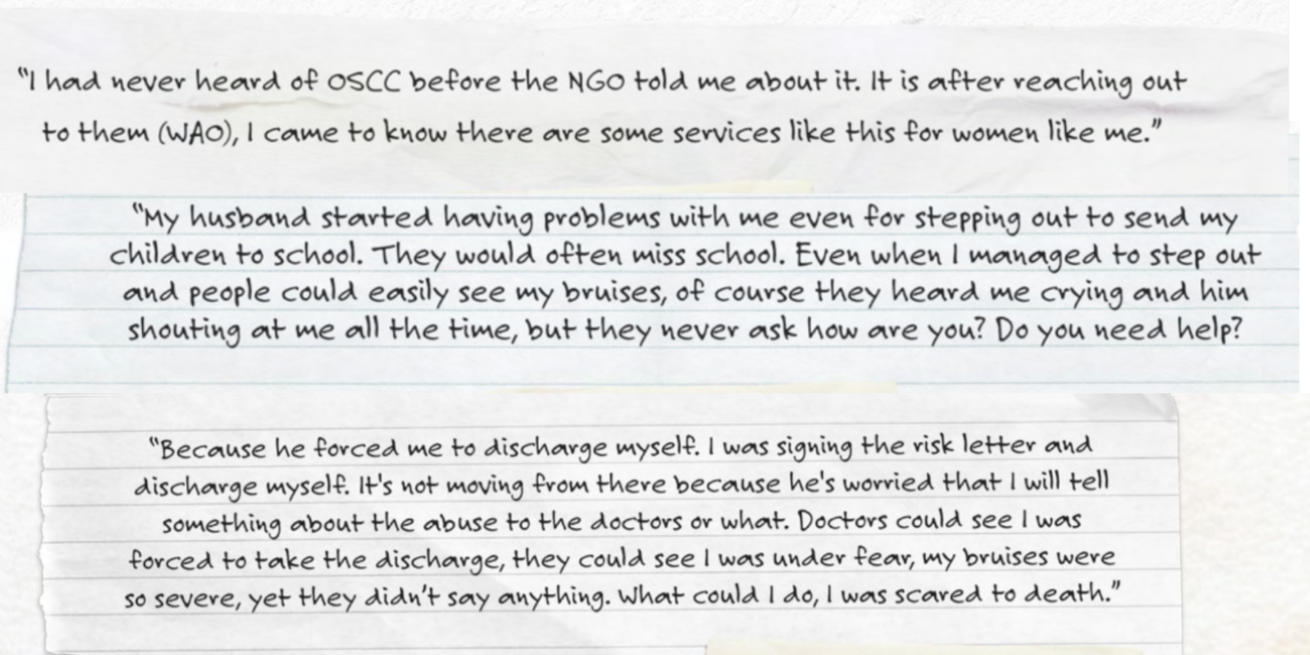
While the OSCC was established in the country over three decades ago, many are not even aware of its existence and the services it provides. The report attributes this primarily to the lack of information about the OSCC in the media and in public spaces. As a result, survivors mostly navigate these services through CSO providers, and it is only with their support and linkages that the survivors can access these services.

The lack of awareness and information extends to the issue of GBV itself, resulting in the shroud of silence and shame that engulf GBV survivors. Several participants reflected on their initial hesitance to seek help or report incidents, attributing this to a pervasive lack of understanding about the nature of GBV and the support mechanisms in place.

For example, Hassan, a male survivor, noted that societal stigma and the absence of targeted information campaigns for men experiencing GBV were the reasons he did not report the abuse and access support services.
The study also found it imperative that community awareness of GBV be enhanced. Due to lack of understanding and awareness, community members often fail to recognise the signs of GBV or understand the importance of providing support to survivors. For example, Nadiah, recounted incidents where clear red flags of abuse went unnoticed by those around her.

Neighbours and friends, despite witnessing distressing signs of abuse, remained bystanders, primarily due to a lack of knowledge about what constitutes GBV and uncertainty about how to act effectively.
Red flags that often go unrecognised include sudden changes in behaviour or appearance, unexplained injuries, and the individuals withdrawing from their normal activities or social circles.
Moreover, subtle indicators such as increased anxiety, fearfulness, particularly around the abuser, or the abuser exerting control of the survivor’s life and decisions are also missed.
Inadequate Provision Of Mental Health Services

The study found a disturbing trend of unmet mental health needs among GBV survivors. A significant proportion of participants reported experiencing symptoms of severe depression, anxiety and post-traumatic stress disorder, with many disclosing suicidal thoughts and attempts.
The trauma experienced by survivors often leads to long-term psychological distress, adversely affecting their quality of life, relationships and ability to function in daily activities. Despite these pressing needs, the study uncovered a stark deficiency in the availability of specialised counselling services tailored to the unique needs of GBV survivors.
Very few participants reported receiving mental health care at the OSCC. The survivors who did receive counselling from the social workers informed that they were provided with counselling only once, i.e., during the first time they went to the OSCC.
Only one participant reported receiving a follow-up call for counselling after one month of discharge. This highlights the severe lack of access to mental health services; available care was often short-term and crisis-oriented, with little to no follow-up or support for dealing with long-term effects of trauma.
Barriers To Accessing Services

Findings show that significant barriers hinder survivors’ access to GBV services. Going to the crowded emergency centre, language barriers, fear of mandatory police reporting, and poorly coordinated service delivery was frequently cited as obstacles to accessing the services.
Survivors, particularly those who have recently experienced sexual violence, reported a heightened sense of vulnerability and trauma when forced to wait in overcrowded emergency centres. The lack of privacy and the potential for public exposure in such settings can deter survivors from seeking immediate assistance.
This becomes more profound when the survivor is transgender or a refugee, who feels being judged or monitored by other people. Additionally, interviews with the survivors from refugee communities show that language barriers play an enormous role in limiting access to GBV services.

The inability to communicate effectively with health care providers and law enforcement officials not only impedes the delivery of care but can also further distress and humiliate the survivors.
Instances of miscommunication or perceived ridicule, as reported by the friend of a survivor, highlight the necessity for language support services, including interpreters and culturally sensitive care, to ensure that all survivors are understood and treated with respect.
The narratives of different survivors of GBV also highlight that the requirement for mandatory police reporting is a formidable barrier, particularly highlighted by a survivor’s fear of being judged or dismissed by law enforcement officials.

According to the report, this requirement often forces survivors into a paradoxical situation where seeking medical help or preventive care becomes contingent on their willingness to navigate the complex and sometimes hostile legal landscape.

Survivors, including those who have experienced domestic violence, expressed concern over their safety and the safety of their children when engaging with the legal system. The fear of retaliation from the perpetrator, coupled with the uncertainty of police protection, underscored the need for a more survivor-centered approach in handling GBV cases.
Safety Of Survivors Not Prioritised

Study findings show that the safety of survivors is not consistently prioritised, with some individuals being advised to stay in potentially dangerous situations or rendered vulnerable during medical examinations.

Moreover, preventative measures aimed to safeguard survivors during the reporting, case management and post-recovery phases are insufficient. Concerns were also raised regarding the protection of the survivors’ dependents, who may be vulnerable to abuse and harm.
This gap in ensuring ongoing security for survivors and their dependents highlights a systemic deficiency within current support frameworks that warrants urgent attention both at OSCC and beyond, to reinforce the safety net for those affected by GBV.

According to the report, even interviews with the survivors suggest that the assurance of safety was notably lacking during crucial stages such as the reporting process, investigation, and legal proceedings. The research indicates that interim protection orders, which are crucial for survivor safety, are often subject to delays.

Furthermore, survivors frequently report being compelled to navigate between multiple police stations to file reports, a process that not only introduces additional delays but also poses an increased risk to the survivor and her family.
The report noted that these systemic obstacles during such a vulnerable time reflect a substantial shortfall in the support infrastructure, underscoring the need for an improved, survivor-centered approach that ensures continuous protection for GBV survivors and their dependents.
Lack Of Professionalism, Judgemental Attitude Of Service Professionals

Despite existing guidelines on GBV services assessment (UN Women, UNFPA 2020) that emphasise the crucial need for service providers to demonstrate an attitude that is non-judgmental, empathetic, and supportive when interacting with women and girls who have experienced GBV, the study found that the service provided fell short of these standards due to significant communication barriers.
This is attributed to professionals who lack the training to recognise non-verbal cues of distress or the nuances of culturally sensitive language, which is critical for effective support and advocacy.
According to the report, survivors have recounted instances of dismissive conduct by police officers, where the gravity of familial abuse was downplayed and survivors were advised to settle matters privately. This not only undermines the severity of the violence but also implicitly endorses the perpetrator’s actions, making the police complicit in perpetuating the cycle of violence.

For instance, one survivor was told by the police, “if you don’t settle the case (within your family), your husband will resent you”. The report noted that this kind of response from law enforcement discourages survivors from seeking help and reinforces the notion that abuse is a private matter, rather than a criminal act warranting legal intervention.

Medical professionals have exhibited a similar pattern of minimization, especially concerning sexual violence within marriage. A survivor’s narrative highlighted the trivialisation of marital rape, as the doctor perceived it as a husband’s right, effectively denying the existence of consent within the marriage. Such attitudes are not only medically unsound but morally reprehensible, denying survivors the validity of their trauma.

Moreover, the act of victim-blaming was glaringly evident in the attitudes of service providers. A police officer, making a character judgment based on the survivor’s appearance, directly questioned her virtue and implied complicity in her victimisation by saying, “from your face I already know you’re not a good woman”.
The report noted that this is not only unprofessional but also a gross violation of the survivor’s dignity, and stands in stark contradiction to the principle of unbiased law enforcement.

Additionally, gender and societal expectations of women’s conduct were used to justify the denial of support and blame the survivors. A doctor’s reprimand, suggesting that a woman should not be out at night and should instead stay home, reflects deep-seated biases and negates a woman’s autonomy and equal status in society.
Deficiencies In Data Collection, Information Management
The study found that data collection and management of GBV incidents are not systematically implemented, especially within refugee communities, making it challenging to understand the full scope of the issue and tailor services accordingly.

The findings based on the narratives of GBV survivors and social workers in Malaysia indicate critical shortcomings in data collection and information management at OSCC. These challenges significantly impede the effectiveness of support services and obstruct survivors’ access to justice.

Firstly, there is a profound lack of communication and consistency in the sharing of medical reports and documentation with survivors. This lapse is exemplified by a survivor’s testimony of not receiving any hospital notes, thereby leaving her without crucial evidence to seek justice.
The report noted that the absence of a clear protocol for sharing documents directly with survivors undermines their autonomy and can delay or deny their legal recourse.

Secondly, there is no standardised approach to record-keeping and data sharing among different entities. While some professionals report meticulous documentation and sharing of details with referring teams and social welfare officers, others note an absence of data sharing, particularly with the Ministry of Health (MoH).

A senior medical social worker highlighted the disconnect, revealing that data at their medical university is not shared with the MoH due to differing ministerial oversight. The implications of such discrepancies are far-reaching. Without a unified system, there is an inability to accurately tally and reconcile data across the police, MoH, and social welfare departments.
According to the report, this fragmentation leads to a disjointed understanding of the GBV situation, making it difficult to assess the scope of the issue, allocate resources effectively, and implement comprehensive support services.
The report emphasised the importance of ensuring that survivors have access to their documentation as it empowers them in their pursuit of justice and serves as a critical tool for advocacy and policy change. Its findings suggest an urgent need for standardised protocols for data management and sharing, as well as the establishment of integrated systems that enable seamless communication among different support services.