
KUALA LUMPUR, April 16 – Meltdowns are often a response to overwhelming external factors and can manifest in a variety of ways.
During a webinar on Insights into Autistic Meltdowns Through Lived Experience organised by the Autism Inclusiveness Direct Action Group (AIDA) last December 8, autistic persons and their allies shared that their experiences of meltdowns included physical, mental, and emotional expressions such as hitting themselves and others, shouting and crying, retreating into themselves, and suffering from crippling depression.
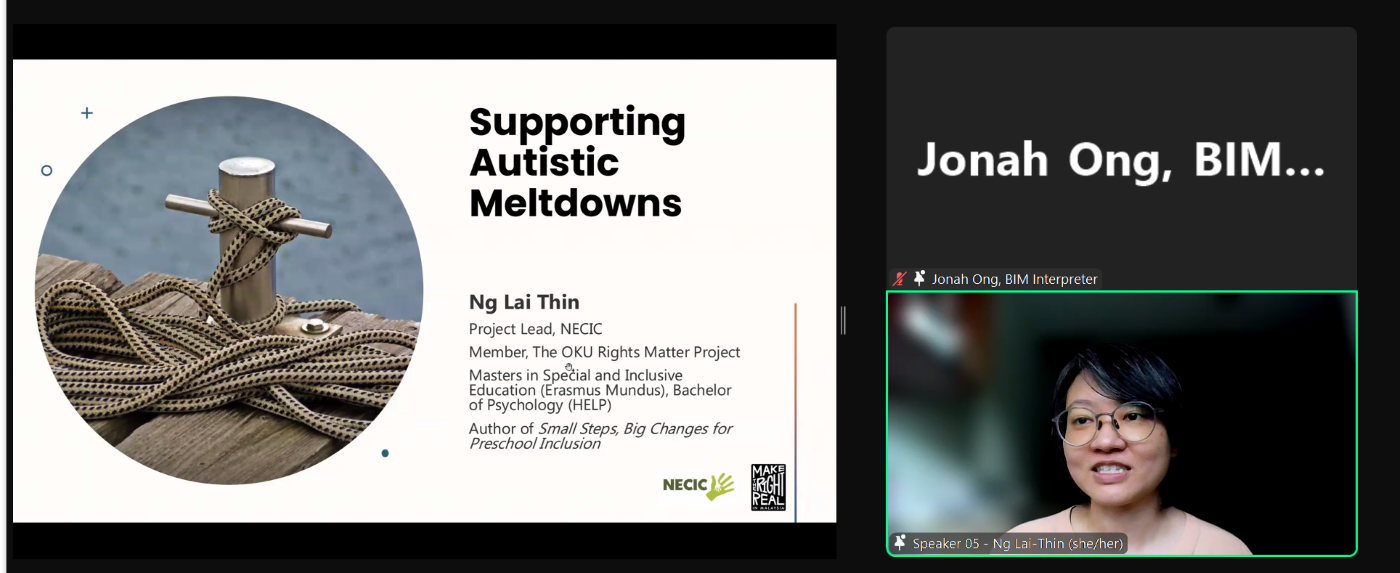
To prevent autistic meltdowns, it is important to create a safe and inclusive environment that accommodates the needs of autistic individuals, said Ng Lai Thin, project lead at the National Early Childhood Intervention Council (NECIC).
“When autistic people are in a safe environment, their brain and body won’t need to constantly direct their energy to cope with things that exhaust them and drain them, make them anxious or give them pain.
“And when they are safe, they will have more energy to direct their channels of attention to learn, work, collaborate and do daily activities.”
However, creating a safe and inclusive environment is not just about sensory-friendly physical spaces, said Ng, who is the author of Small Steps, Big Changes for Preschool Inclusion, a guidebook that provides teachers with practical suggestions to include children with disabilities in early childhood education settings.
“It is also about including regular uninterrupted time in activities that give us joy and blocks of time for us to self-regulate and co-regulate into our own daily routine, school routine and work routine.”
Triggers That Can Lead To Meltdowns
Ng, who has a Masters in Special and Inclusive Education, and Bachelor of Education in Psychology from Help University, said sometimes it’s not that autistic people cannot express themselves clearly.
Although there are such cases, most of the time it’s that the people around them do not understand or believe what the autistic person says they need.
“And a lot of people don’t believe in the way they experience the world. For example, a child says that she’s in pain, but other people around her keep telling her that she’s fine.
“But actually, she’s experiencing a bad migraine because of the buzzing of the flickering lights and LED screens in front of her,” Ng explained. “So we need to be open-minded and also listen to autistic people about how they experience the world and believe in them.”
Build-up of stress that can lead to meltdowns are also caused by physiological needs that are not addressed like lack of sleep, pain, and being chronically ill, according to Ng.
She added that other triggers are unexpected changes in planned activities and in the environment. “Sometimes it’s a supermarket changing the location of the shampoo to a different shelf, a manufacturer changing the design of the packaging, or an app developer changing the app layout or the colour of the icon.”
Another trigger is tasks perceived as difficult or requiring a lot of energy. “When an autistic person thinks that the task is too difficult for them, even for tasks that they have previously done with a lot of success, if they think that it is difficult for them at that time, the stress can trigger a meltdown,” Ng said.
“This is especially when they are low in energy or if they are already in a burnout phase.
Lack of control or autonomy in their lives can also be a trigger factor. “This is especially true for those who have almost every single thing in their life planned for them.”
A Safety Plan For Meltdowns
However, sometimes even with all the preventive measures taken, meltdowns can still happen, said Ng, adding that it would be useful to have a safety plan for such cases.
“For that, we need to know the signs of a pending meltdown, find out from the person or find out from other autistic persons.”
Being the person an autistic individual can feel comfortable enough to confide about an impending meltdown is beneficial.
“You can help them during the pre-meltdown phase by being someone they can say to: ‘Hey, I feel the meltdown is coming’,” Ng said.
A safety plan should include strategies to support a meltdown, especially to remove or reduce the impact of possible triggers, and should be flexible with rules and expectations, and offer more time and space.
“If you’re going out in a school or workplace setting, pre-identify areas that can be relatively safer to be in if a meltdown happens.”
Ng, said when faced with the prospect of meltdown, the first thing to do is not panic and rush into action, or speak immediately.
“Pause, try to find your calm, ask yourself, do I feel in control or not? And how can I help this person and others be safe?,” she explained.
“Is it possible for me to guide the person to a safer space? And all these happen in the span of a few seconds. Offer your caring and compassionate presence, but again, maintain a safe physical space.
“If you need to speak or move or sigh, do so at a slower pace, because they’re already in a heightened fight or flight mode, so any movement can be felt as a threat.
“And while you do that, you should also observe and listen to the person and the environment around you.” Ng said, adding that at this point, try to evaluate the sources of stress that can be removed or mitigated.
“What kind of accommodation strategies can you use to help the person calm down from the meltdown?
When the meltdown is ending, offer validation of their feelings and experiences.“One of the things you can say to them is: ‘this place is messy, or, I can imagine that this place is a bit too much for you’. Or just simply sit together with them in silence for some time.”
Ng maintained that if an autistic person is in a meltdown, it is crucial to remove the sources of stress, whatever they may be.
“Even if it is you. It can be difficult to do, but it is important. Because the most important thing that you want to do is for the autistic person to feel safe. And for them to de-accelerate, come down from the meltdown.”
She said autistic people will still need support after a meltdown. “They need the three ‘R’s — rest, regulate and recover,” Ng said, adding that this may take days or weeks.
“Give them the space that they need, but at the same time, encourage them to do activities that help them to feel good and bring them joy. Sensory positive activities that help them to regulate and recover.
“Sometimes, depending on the individual, maintaining a usual routine can be helpful. Because it gives them predictability and consistency.”
Case Study For A Safe, Inclusive Environment For People Of Various Disabilities

Ho Lee Ching, a neurodivergent person who lives with Tourette’s syndrome and other co-occurring conditions, is founder of Teater Untuk Semua (theatre for all), a research and documentation project for more accessible theatre training. Her project involved 12 participants of various disabilities including participants who were blind, deaf, autistic, wheelchair users, and had Down syndrome.
Ho said she sought to create a safe environment where participants can be at their “optimal activated state”, which included being safe, open, curious and playful. In order to achieve this, Ho said she first had to assess the participants.
“I would assess where the participants were, whether within, on the edges of, or maybe outside of their windows of tolerance. She explained that everybody has their own window of tolerance that determines how they respond to the physical and sensorial stimuli around them.
“From this, I adjusted our activities (accordingly). And I would do this as a group activity because (of) neuroception.”
Neuroception is the body’s unconscious ability to detect safety or danger in the environment, according to Ho.
“We do this automatically, without thinking and whether you realise it or not, our body is constantly responding to a lot of things.
“So, let’s say someone needs sometimes to just lie down and do nothing, I would make it a group thing because then you are sending safety cues in the environment.”
Importance Of Safety Glimmers
Ho explained that she also established safety glimmers, which are resources to help participants feel safe.
“This includes structured things such as check-ins at the beginning, warm-ups. It’s the same warm-ups every session and closing activities to just create predictability and reduce stress.
“For our warm-ups, we use somatic techniques like tapping, humming, brushing, squeezing to help our participants turn inward and allow everyone to spend some time and space to reorganize and express and arrive in their own bodies and as a group.
She said presentation slides were also prepared so that participants who preferred to process through text and images, as opposed to processing verbal explanations, wouldn’t feel stressed out about needing to catch up.
Another safety glimmer was a calm space within the space of the project itself. “Not outside the space, so that whenever they want to, they can go there, but they can still feel like they’re part of the group in their own way,” Ho explained.
“Sometimes they would go into the calm space — it was behind this curtain — and they would peek out to observe, and to me, that’s their form of participating.
“Other times, they would actually follow the activity we were doing in the group. Let’s say we were doing our vocal warm-up, and they would be in their calm space, they would also do it in their calm space.”
The project also created a role called creative support persons (CSPs) as a safety peer for participants.
“These CSPs were experienced theatre makers and were the buddy and the safe person for our participants.
“Because we had a medium to large size group, we wanted our participants to always feel like they had someone they could approach, let them know if they needed anything, or ask questions, especially if they did not feel like they could ask in front of the group.”
In conclusion, Ho emphasised the significance of safety glimmers.
“Safety glimmers are extremely important so that we are able to set up a space, an environment, where persons with disabilities and autistic individuals can show up as their whole selves: their way of being, their way of doing things, to just be themselves among others in the space.
“Because only then are they able to access safety, which leads to more openness to experience play, creativity, pleasure, and joy.”