


KUALA LUMPUR, Jan 14 — Cancer remains one of Malaysia’s most pressing public health challenges. In 2023, it became the country’s third leading cause of death, accounting for approximately 13.8 per cent of all fatalities, with cancer-related mortality continuing to rise through 2024.
Despite advances in health care, many patients continue to face barriers to effective treatment, including high costs, limited access to precision therapies, and uneven availability of specialised care.
For Prof Dr Yeong Chai Hong and her multidisciplinary team at Taylor’s University, this challenge is both professional and personal.
“As both a medical physicist and a Malaysian who has seen friends and family struggle with cancer, I am deeply motivated to create treatments that are not only effective but also affordable,” she shared.
“Our goal is to make precision cancer care available to all, not just those who can afford it.”
This commitment has driven the development of two complementary innovations at Taylor’s University — RadioEmbolisation Samarium Therapy (REST) and the Biodegradable Holmium-166 Rods.
Together, they form a flexible, image-guided theranostic ecosystem designed to address different tumour types and clinical needs, rather than a one-size-fits-all solution.
REST: Precision Radiotherapy Via The Bloodstream
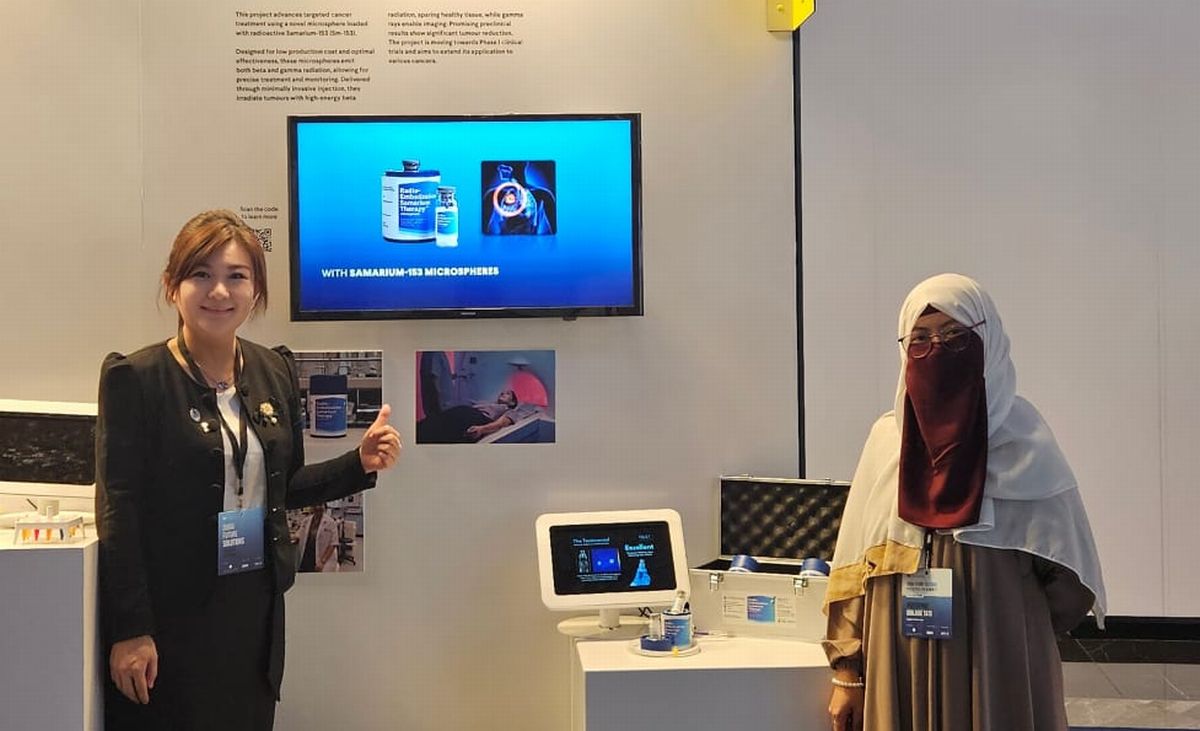
REST is a minimally invasive internal radiotherapy approach designed for small to medium-sized, well-vascularised tumours.
It utilises Samarium-153 (Sm-153), a relatively low-cost radioisotope that emits high-energy beta radiation to target cancer cells, alongside low-energy gamma emissions that enable imaging and treatment monitoring.
In REST, biocompatible microspheres carrying Sm-153 are delivered to tumours through their blood supply. This targeted delivery allows radiation to be concentrated within the tumour while minimising exposure to surrounding healthy tissues.
Pre-clinical studies have shown encouraging tumour reduction, and the team is currently preparing for Phase I clinical trial to assess safety, dosimetry, and early signals of efficacy. Potential applications include breast, liver, pancreatic, and lung cancers.
A defining feature of REST is its personalised treatment planning. Patient-specific dose calculations are informed by imaging techniques such as gamma imaging and Computed Tomography (CT), allowing tumour size and location to be carefully assessed.
The team is also developing a treatment planning system that integrates imaging data and radiation dosimetry to support more precise clinical decision-making.
“Beyond survival, REST is also about quality of life,” Dr Yeong explained. “It can offer palliative benefits through fewer hospital visits, reduced side effects, and lower overall treatment burden, particularly for patients with advanced disease.”
Addressing Larger Tumours: Biodegradable Holmium-166 Rods
While REST is effective for tumours with suitable blood supply, not all cancers can be treated through vascular delivery.
Larger, irregular, or poorly perfused tumours often exhibit chaotic blood flow, leading to uneven radiation distribution.
To address this limitation, Dr Yeong and her team developed the Biodegradable Holmium-166 Rods as a complementary solution.
Placed directly into the tumour, the rods enable image-guided radiation delivery with greater spatial control for larger or more complex tumours.
The rods are biodegradable and retain more than 99 per cent of the radionuclide within the implant site over the therapeutic period (approximately 200 hours), before safely dissolving and being naturally cleared from the body.
As Holmium-166 is imageable, clinicians can verify placement and dose delivery using imaging techniques such as Single Photon Emission Computed Tomography (SPECT) or CT. Early studies, particularly in liver tumours, have shown encouraging results.
Recognition On The Global Stage
The international research community has taken notice of these developments. REST was selected among the Top 100 innovations at the 2024 Prototypes for Humanity exhibition in Dubai, chosen from more than 2,700 applications worldwide.
Building on this momentum, the Biodegradable Holmium-166 Rods were named among the Top 10 Groundbreaking Innovations at Prototypes for Humanity 2025, selected from over 4,000 global submissions.
“These recognitions validated years of multidisciplinary work driven by clinical need in cancer care,” Dr Yeong reflected.
“They showed that Malaysian-led research can stand alongside leading global innovations, particularly in affordable and impact-driven health care.”
Both innovations reflect Taylor’s University’s commitment to research with real-world relevance.
Supported by the institution’s School of Medicine and Ministry of Higher Education national research grants, the innovations bring together medical physicists, biomedical engineers, radiologists, and clinicians.
Looking ahead, Dr Yeong sees REST and the Holmium-166 Rods as part of a broader shift toward theranostics, where therapy and diagnostics are seamlessly integrated and responsibly translated from research into clinical practice.