
KUALA LUMPUR, August 22 – Although Malaysia is a party to international conferences and has signed several international human-rights conventions, which provide strong recommendations on the eradication of female genital cutting (FGC), the prevalence of FGC in Malaysia remains high among Malay Muslims.
The Orchid Project, an international NGO working to end Female Genital Mutilation/Cutting, estimates an FGC prevalence of 93 per cent among the female, ethnic Malay population in the country, in its Country Profile on FGC in Malaysia.
As there is no study to date that represents prevalence in terms of population or geography, the figure was derived from several studies in various provinces in the country that found FGC prevalence ranging from 79.4 per cent to 99.3 per cent.
There is insufficient data to estimate prevalence among non-Malay Bumiputera, although there is anecdotal evidence that FGC is also practised by members of the Orang Asli, as well as Sabah and Sarawak’s indigenous population, according to the Country Profile.
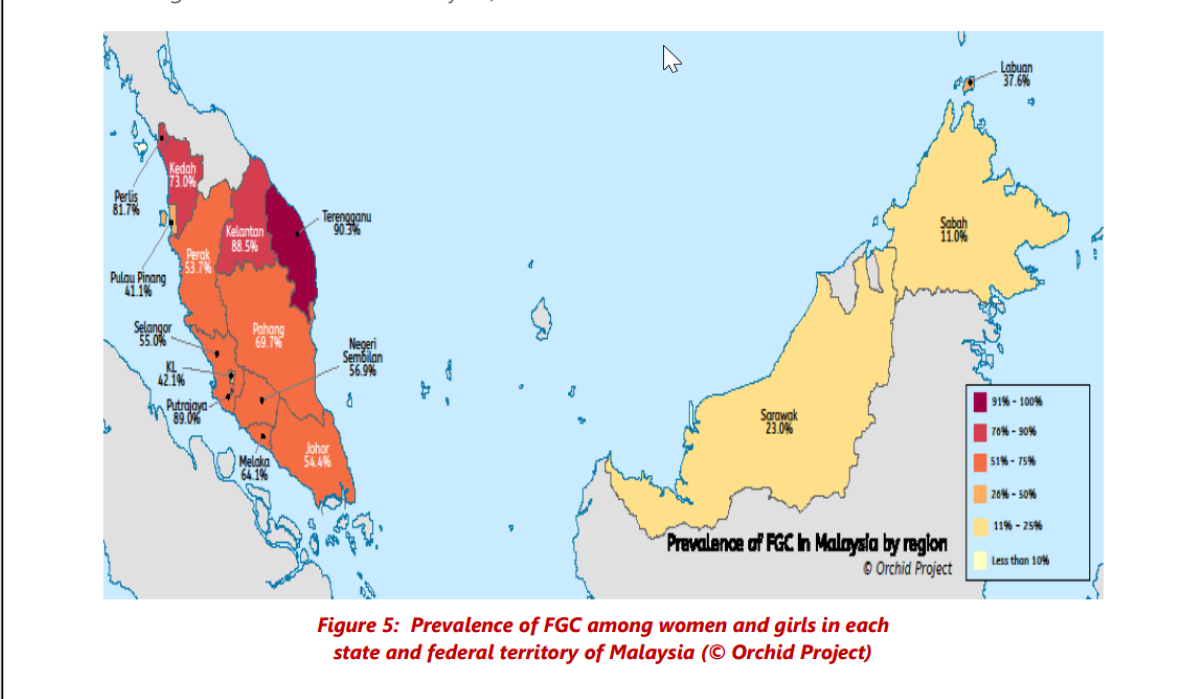
Based on the 2020 census which indicates that 8.1 million female Malay Muslim citizens reside in Malaysia, the Orchid Project estimated the prevalence of FGC in each Malaysian state and federal territory. The figures were derived from the estimated national prevalence of FGC and the number of female Malay Muslims in each state or federal territory.
In total, the figures suggest that more than 7.5 million women and girls are impacted by FGC in Malaysia.
This estimate does not take into account the Orang Asli, the indigenous people of Sabah and Sarawak, refugees or non-citizens of Malaysia.

In Conflict With International Treaties And Conventions
Although FGC has been a longstanding traditional practice in the country, its high prevalence is in conflict with Malaysia’s involvement in international treaties and conventions.
Malaysia was a party to the International Conference on Population and Development in 1994 and agreed to end harmful practices, including FGC and child marriage.
The country is also a signatory to the Beijing Declaration. Article 96 of the Beijing Declaration states: The human rights of women include their right to have control over and decide freely and responsibly on matters related to their sexuality, including sexual and reproductive health, free of coercion, discrimination, and violence.
Malaysia has ratified the Convention on the Rights of the Child (CRC), which explicitly prohibits traditional practices that affect children’s health.
Article 24(3) of the CRC states that “State Parties shall take all effective and appropriate measures with a view to abolishing traditional practices prejudicial to the health of children”.
Malaysia has also ratified the Convention on the Elimination of All Forms of Discrimination Against Women (Cedaw). Article 5(a) of the Cedaw recommends that state parties: modify the social and cultural patterns of conduct of men and women, with a view to achieving the elimination of prejudices and customary and all other practices which are based on the idea of the inferiority or the superiority of either of the sexes or on stereotyped roles for men and women [. . .].
While not explicitly mentioned, FGC falls under such a cultural pattern and customary practice.
In 2010, one year after the federal interpretation on FGC issued by the Department of Islamic Development Malaysia (JAKIM), Malaysia withdrew its reservation toward Article 5(a).
According to the Country Profile, this removal was seen as a positive step in Malaysia’s commitment to end discrimination towards women.
The Cedaw committee expressed deep concerns in 2018 about the 2009 fatwa decreeing FGC obligatory and about the 2012 Ministry of Health (MOH) guidelines reclassifying FGC as a medical practice, allowing its performance in health care facilities and endorsing it as a ‘medically safe and beneficial practice’.
The committee also stressed that FGC could not be justified on religious grounds nor be authorised by fatwas and was a harmful practice, irrespective of the extent of the cut or whether the cut is performed in a medical setting.
Malaysia Urged To Ban And Eliminate FGC
Malaysia was urged during Cedaw discussions to ban and eliminate FGC. In response, the Malaysian delegates pointed to a Malay interpretation of Shafi’i teachings and the fatwa exemption in rare cases of harm, while the MOH defended it as a harmless procedure performed under medical guidelines, comparable to vaccination.
FGC was later described as a ‘cultural responsibility’ that was not comparable to the African practice.
According to the Country Profile, in 2023, Cedaw issued requests for more information on the prevalence of FGC in Malaysia among girls aged 0 to 14 years in each state, as well as on the programme to eliminate FGC in accordance with the Sustainable Development Goals.
The Malaysian government’s reply stated, “Data on FGM is not available as there is no practice of FGM among girls up to 14 years old in Malaysia”.
At the 88th Cedaw session in May this year, the committee asked what measures are being taken to promote an understanding of the criminal nature of and the need to eliminate FGM, particularly targeting medical staff, parents, community leaders and religious scholars?
Sirajuddin Suhaimee from Jakim responded, “I would like to inform that Malaysia takes seriously the recommendation by Cedaw with with regard to FGM. At the same time, we continue to listen to divergent views from the local context on this issue.
“Since the last Cedaw review, the government has intensified the discussion on this issue at the highest ministerial level with a view to further bridge the gap between relevant stakeholders.
“We also undertake engagement with religious authorities, especially state, civil society organisations, medical experts and professionals, as well as academicians to improve the body of knowledge regarding female circumcision.”
Sirajuddin added that the practice of female circumcision is non-obligatory by law and purely voluntary.
“As our society evolves, the information on this practice is becoming more available. Malaysians have become more aware that the practice is purely grounded in culture and has no health benefits.
“But like any other generational cultural practice, it takes time to transform the mindset and to reconcile the divergent views.
“We also recognise the risk of abruptly banning the practice of female circumcision without the acceptance from the community. I understand the concerns raised on this issue and we appreciate the space and time given to us in addressing this issue based on the Malaysia context.
“We welcome continued conversation and we look forward to learning best practices from the international community.”
No Law Prohibiting FGC In Malaysia
No civil law in Malaysia specifically prohibits FGC, nor is there support for criminalisation, according to the Country Profile. FGC is not mentioned in provisions for, or even associated with, children’s rights or gender equality.
The Child Act was enacted in 2001 to fulfil Malaysia’s commitment to the Convention on the Rights of the Child and was based on the CRC’s four core principles.
The Country Profile notes that, however, it does not seem the Child Act can be invoked in FGC cases, despite their strong link to the CRC and the strong commitment of the Malaysian government to address violence against children.
In terms of Gender Equality, the Ministry of Women, Family and Community Development has long shown an interest in introducing a Gender Equality Act, but such an act is yet to be finalised and implemented, notes the Country Report.
As ‘circumcision’ in Malaysia is seen as a legally religious practice relative to both boys and girls, it seems unlikely that FGC would be regulated under an approach to gender equality, despite the Cedaw recommending the end of ‘all forms of discrimination against women’.
Low Level Of Support For Criminalising FGC

A survey conducted in 2022 among young people aged 15 to 25 in all Malaysian constituencies found low level of support for criminalising FGC:
- 18 per cent of young people would make FGC illegal, which might indicate an upward shift compared to the near-universal support for FGC reported in earlier research reports
- More women think that FGC should not be made illegal than men (82 per cent of women are against criminalising FGC, compared to 70 per cent of men)
- More young Muslims who attend religious schools believe FGC should not be made illegal than those who do not attend (84 per cent compared to 72 per cent).
- The highest level of support for making FGC illegal was found in Sabah and Sarawak (24 per cent compared to 14 per cent in the highest-practising states, in the north of Malaysia). This is interesting as there is no data available on types of cutting, FGC’s prevalence and attitudes toward it in those two states, notes the Country Profile.