
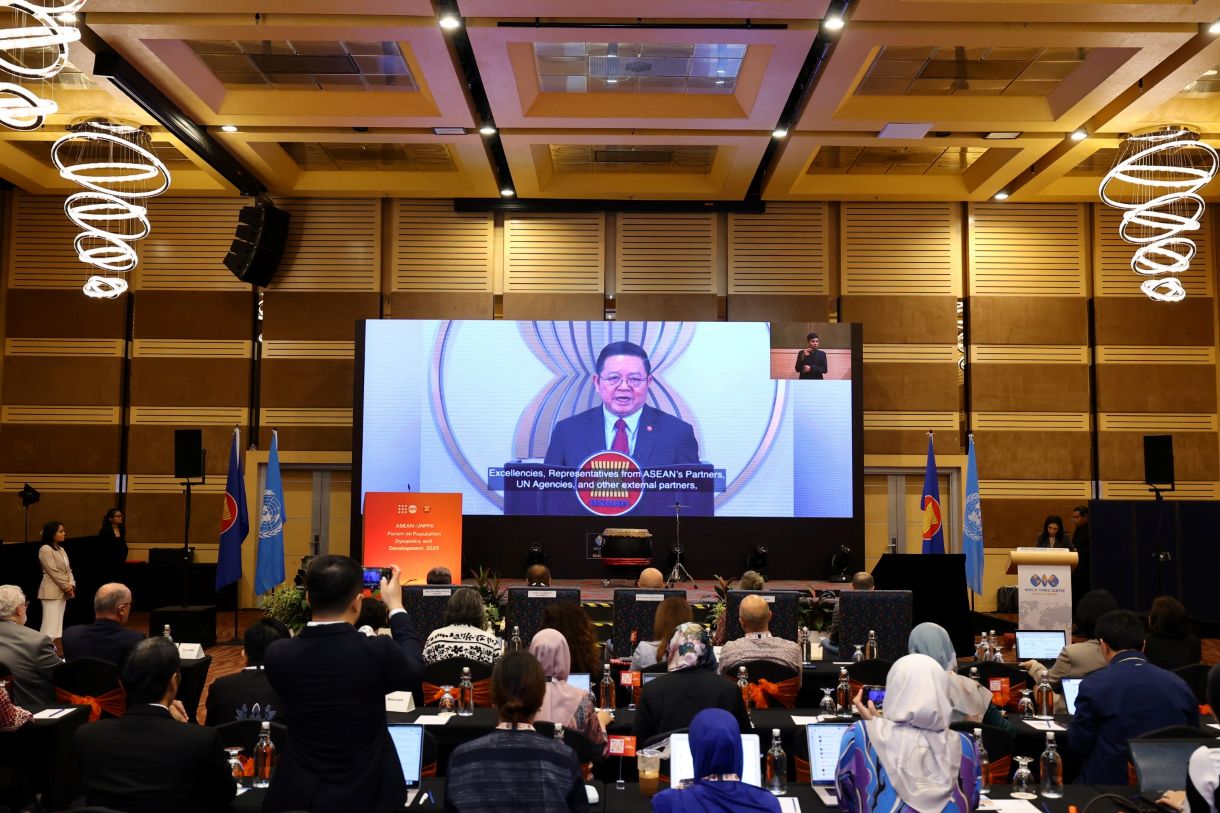
KUALA LUMPUR, Nov 13: Asean has the benefit of foresight, having witnessed wealthier nations struggle with low fertility rates and massive economic headwinds due to a lack of comprehensive policies to address these issues from the onset, said Asean secretary-general Kao Kim Hourn.
In a pre-recorded message delivered at the opening of the Asean-UNFPA Forum on Population Dynamics and Development 2025 last November 10, Kao said the region should capitalise on this advantage by moving beyond incremental policy adjustments as it manages its own demographic transition, which ranges from a mass of youth in some areas to rapidly ageing populations in others.
Current population figures and projections indicate that 8.1 per cent of Asean’s population or 55.9 million people in the region were aged 65 and above in 2023.
The number of people making up the older population in Asean is expected to rise to 128.7 million by 2050, accounting for 16.3 per cent of the region’s total population.
Taking this into account, Kao said a move away from the traditional, linear model of education, work and retirement should be an imperative.
“Instead, we should consider a perspective that emphasises active ageing and views all citizens as lifelong human capital,” he said.
“This means prioritising continuous upskilling and reskilling, recognising that every stage of life represents a phase of peak potential.”
Japan Reaping Silver Dividends
“Japan has shown us the concept of ‘silver dividends’ — workers aged 55 and above exhibit lower absenteeism and higher productivity in certain sectors, revealing that ageing populations represent not just a challenge but significantly underutilised economic potential,” Kao said.
Adopting this approach also means integrating flexible work and caregiving structures to maximise workforce participation across all ages and genders, he added.

Shaharuddin Abu Sohot, chair of the Senior Official Committee for Asean (SOCA), also highlighted the need to review relevant policies on education, labour, health, and social protection in line with the varied demographic landscape.
“For decades, Asean has leveraged a youthful population for rapid economic growth. However, that powerful demographic dividend is shifting. Our collective challenges, as we are all aware, are rapid ageing and declining fertility,” said Shaharuddin, who is also the secretary-general of the Ministry of Tourism, Arts and Culture Malaysia.
He said the Asean population stood at approximately 682.7 million in 2024, representing 8.4 per cent of the world’s total, positioning the region as the world’s third largest population block, after China and India.
“While the region maintains significant momentum from youth (with almost half the population under 30), it is also experiencing a rapid demographic shift. The elderly population, now 8.2 per cent in 2024, has almost doubled the figure recorded back in 2000.”
He added that Asean member states are in a unique position to learn from one another’s policy responses and interventions in dealing with the wide-ranging demographic spectrum from youth to rapidly ageing populations.
Rights-Based, Inclusive Policies, Interventions Ensure No Is Left Behind

In her welcoming remarks, Dr Julitta Onabanjo, UNFPA in Malaysia country representative said that Asean’s interconnected demographic picture calls for a shared space for member states to learn from one another’s demographic trajectories in order to design forward-looking evidence-based policies rooted in rights-based and inclusive approaches.
“Our interventions, whether to address – ageing, youth, fertility, unpaid care work, female labour force participation rate, maternal mortality, gender-based violence and harmful practices, or sexual and reproductive health and rights (SRHR) – must ensure rights and choices for all, and leave no one behind,” she said.

In his keynote address, Dr Aleksandar Bodiroza, deputy regional director for UNFPA Asia and the Pacific, echoed the call for investing in rights and choices, saying there is an economic case to be made for it.
“New UNFPA research shows that every $1 (RM4.13) invested in the health and education of girls delivers a return of nearly $10 (RM41.33),” he said.
“Will we be a region that invests in the potential of every girl, or one that leaves talent behind? Will we honour elders as the active mentors they are, or will we see them as a burden?
“We stand at a pivotal moment,” Dr Bodiroza said. “Investments in rights and opportunities allow families to thrive, societies to prosper, and economies to grow stronger.”
The two-day forum held on November 10 to 11 in Kuala Lumpur featured thematic discussions on ageing, youth, fertility, families, and migration.