

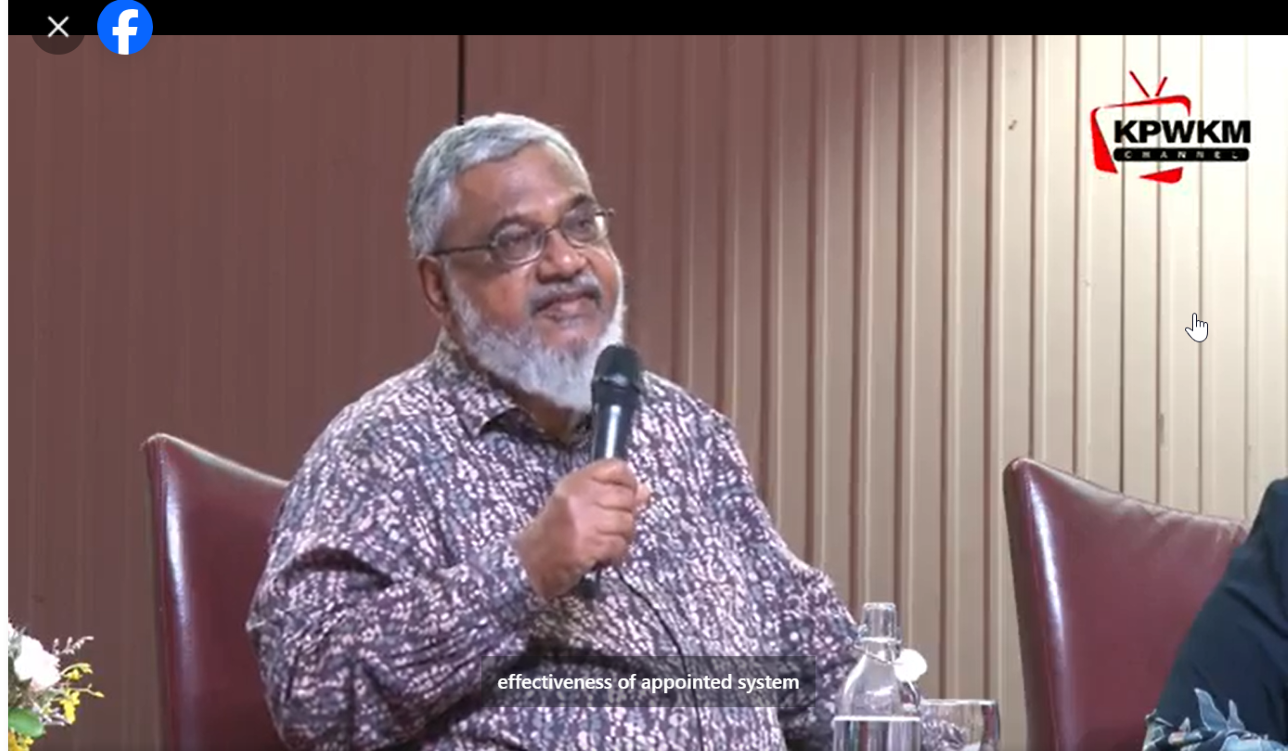
KUALA LUMPUR, Nov 4 – If you were to look at the figures in the National Social Policy 2030, it would appear that Malaysia is doing very well, said Prof Denison Jayasooria, head of the secretariat for the All-Party Parliamentary Group Malaysia on Sustainable Development Goals (APPGM-SDG).
“We don’t need a policy, everything has already been achieved,” he said.
However, quantitative data must be balanced with qualitative data to obtain a more accurate picture of what is happening, especially when it comes to the grassroots community, he said at a forum to mark the launch of the National Social Policy 2030 (Dasar Sosial Negara 2030, DSN 2030) last October 21.
The problem with statistics and broad numerical data is that it doesn’t address the humanity of the situations that grassroots communities face, said Denison, who is also a senior fellow with the Institute of Strategic and International Studies (ISIS) Malaysia.
Reality Check On The Statistics
According to Denison, a more disaggregated approach to data collection, that involves monitoring, such as through case studies, will help in the formulation of policies that can actually deliver to the communities in need.
“As it says in the SDGs (Sustainable Development Goals), you leave no one behind,” he said. “However, if there is no monitoring, just statistical data, we lose the reality on the ground,” he said.
“My committee members on the APPGM told me I’m a city dweller, I wouldn’t understand the issues in Sarawak. They told me to take a drive on a four-wheel vehicle from Kuching to Sibu or travel by boat to a rural area — only then will the issues facing the communities such as (poor) infrastructure, quality of life will emerge.”
He suggested that academics from public universities can assist in giving the ministries and DOSM (Department of Statistics Malaysia) a reality check on the statistics. “It shows that everything is good but when we go to the grassroots, we see the suffering of the citizens.”
Seemingly Petty Issues Can Trigger A Lot Of Social Issues
However, another panel member of the forum, Roziah Omar, CEO of Global Edu Consulting, said that when it comes to research as a social scientist, her experience was that qualitative research projects are often denied high-paying grants.
Additionally, she said that without data, it would be difficult to anticipate the future needs of the country.
“For example, when education is provided to women – we are seeing more women in (educational) institutions now, and when there are many of them, when they come out, there is a gender gap.
“In developed countries, when women are empowered , they don’t want to get married. This has happened in Singapore, this has happened in Hong Kong.
“This is another aspect of social issues that the country will have to address in 2030. In the future, we don’t know what is going to happen.
“And to address women’s issues is not easy,” continued Roziah, who is also director of Institut Sosial Malaysia. “If half of the population are women and they decide, no, I’m not going to get married, I’m not going to have kids, that is going to be a problem for the country.” She added that issues that seem petty can trigger a lot of social issues.
Culture, Religion Distort Role Of Men In The Household
However, Denison cited the issue of domestic violence as an example to show how merely relying on statistics can come up short when it comes to reflecting the extent of a problem and its complexities. He pointed out that DSN 2030 mentions domestic violence but it is measured by the number of cases reported to the police.
“During focus groups discussions at the grassroots level, we have observed that when there are men and women in a group, women’s issues are not brought up. Men will assume the dominant role in the focus group discussion,” he explained.
“So, our team will break them up after the briefing to separate groups for women and men. That’s when we learn that there are so many issues of domestic violence at the grassroots level, and this is regardless of race.”
Denison attributed this to culture and lack of awareness about laws, and changes that are taking place. “Because here (at the grassroots level) the burden of family is (still) largely extended to women.”
According to him, Khazanah Research Institute conducted a study on family models. “The first model is the husband works and the wife is a housewife. In the second model, both the wife and husband work, but the wife has a second non-paying job, which is taking care of the house and household. The third model is wife works, husband works, but the husband helps out at home,” he elaborated. “So, which model are we in?”
While Denison said his parents fit the mould of the first model, it is a system that is “unequal, unjust because culture and religion distort the role of men in the household.
“So, we are doing a micro study on the psychology and stress level of women. Only through qualitative data can you get this. ”
How To Strengthen National Social Welfare Council
Another area of concern with DSN 2030 is how to strengthen the National Social Welfare Council (Majlis Sosial Negara, MSN), which oversees the implementation and assessment of the policy, Denison said.
“If I’m familiar with cabinet committees and the like, meetings are usually held every one or two years. How strong is the secretariat at the federal, state and district level to really assess and secure inter-agency cooperation?” he asked.
Denison, who said that he has visited various communities including rural Malays, Ibans, Kadazans, paddy farmers, and fishing villages, found that there are many issues on the ground.
“My appeal, as part of this discussion, is to re-emphasise the great need on the ground. We have so much money and resources. Just look at the allocation of RM300 billion for operational expenditure next year. We have the money, but somehow, we are not pulling up the (grassroots) areas.”
Return To Local Government Elections
DSN 2030 also does not address ground level governance, Denison said. “I really think we need to return to local government elections. A lot of reps (ADUNs and MPs) are now doing local councillor jobs and not their parliamentary duties. Which is why a policy like this needs to be discussed with the MPs and such.
“But at the grassroots, it requires greater democratisation. Because as it is now, regardless of whether we are under Barisan, PN, or even the unity government now, the effectiveness of the appointed system at the grassroots doesn’t work because you have different leaders in the state government from the federal government.
“You got a different welfare list from the other. So, we need stronger bi-partisan action to address poverty.”
He pointed out that DSN 2030 also highlights Malaysia’s obligation to international commitments such as Cedaw (Convention on the Elimination of All Forms of Discrimination against Women), CRC (Child Rights Convention) and CRPD (Convention on the Rights of Persons with Disabilities), and others.
“So, it’s not just charity, but it’s actually a rights-based approach to development.”
In Malaysia, emphasis must be placed on inclusive development, Denison said. Throughout the country, there are many areas in need of development and many forms of poverty that need to be addressed.
People Living In Longhouses Pay RM200 For Drinking Water
“My family and I living in Subang pay only RM6 a month for water. In Mukah (Sarawak) in the longhouses, they pay RM200 for drinking water. Because they use mineral water. (Use of water) for everything else is from rainwater harvesting and the rivers.
“Just for cooking and drinking, they spent about RM200 to RM500. This is a grassroots community. So, what is their savings, what is the income for other areas of life? So these are things we need to think about.”
According to Denison, when government agencies and political organisations go on the ground, it is to give briefings or to launch or officiate a programme. “Not to listen to the concerns of the grassroots. Not to listen to the voices of the citizens. This is important to democratise defining the agenda and policy.”
There must be strong collaboration between the government, private sector, civil society and academia, he said. Aside from that, to ensure the success of DSN 2030 will require objective analysis, professional monitoring, and transparency of data.