


KUALA LUMPUR, Oct 14 – While Malaysia has some good policies, it is “very ageist” when it comes to its senior citizens, said Tengku Aizen Tengku Abdul Hamid who is on the committee of the National Council of Welfare and Social Development Malaysia.
Speaking at a Caregiving Conference organised by the Seterra group of companies last August 8, she said: “We need to look at age as a discriminatory crisis in our society. Because you cannot get insurance at the age 60 and we are not valuable at that age.
“But if you want to promote senior entrepreneurs, you have to look at all these policies that are barriers for the older people to be active, productive, and also to develop a creative life.”
This is why she said the care economy has to be viewed from both the macro perspective as an engine of productive growth, “it is a determining factor of economic outcomes”, and from the rights-based perspective.
While some people might be averse to the concept of rights-based, said Tengku Aizen, this perspective needs to be taken into account as older people are set to comprise a huge proportion of the Malaysian population in the future.
“The outcome of ageing is an unintended or unplanned consequence of economic development. So in that perspective, they are also citizens. Why are they different from other components of the citizen(ry)?
“So when you talk about the rights-based perspective to care, the care economy is described as a social organisation at the heart of the transformative agendas such as gender equality, demographic change, disability dissolution, global mobility, climate adaptation and more.”
Distinction Between Health Care and Social Care
It is also closely intertwined with health care although there is a distinct difference between the two forms of care.
“If you look at social care, it is defined as care aimed at healthy individuals who face challenges due to age, between the young and the old, people with disabilities, or under certain circumstances, for example, people who may need palliative care, said Dr Saidatul Norbaya Buang, deputy director, Family Health Department Division, Ministry of Health (MOH).
“And most of this care is related to day-to-day living, for example, helping those people with how to eat, prepare food, dress themselves, transportation, and so on.
“In some cases, social care also includes protection, for example, services being carried out by Jabatan Kebajikan Masyarakat (Department of Welfare), having homes to protect children” she said, adding that social care in Malaysia likely falls under the stewardship of the Ministry of Women, Family, and Community Development.
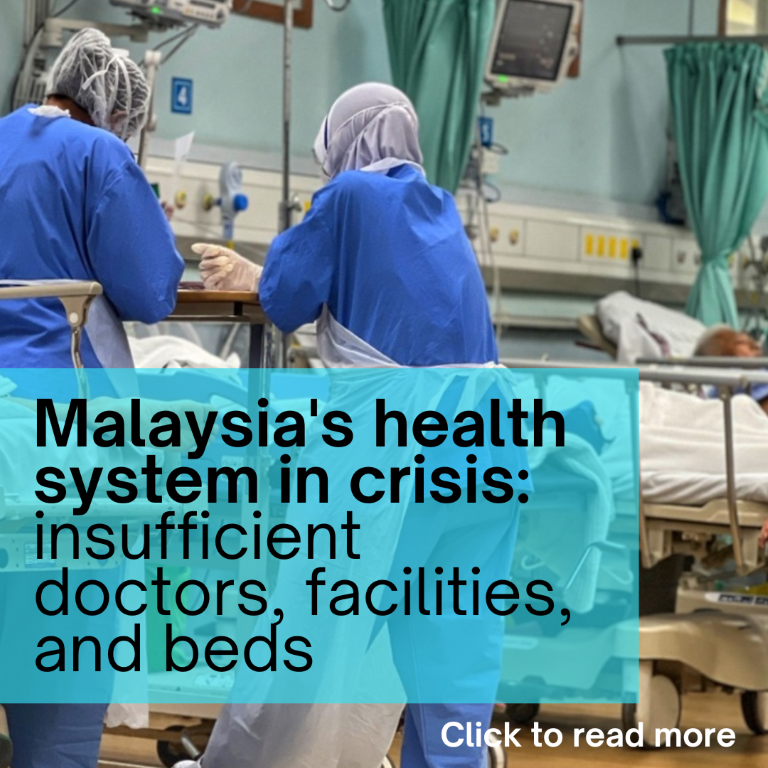
Health care is a very specific service, which involves prevention,detection and treatment of disease, she continued. In Malaysia, there is a dearth of qualified health professionals to tend to the country’s rising elderly population.
Massive Dearth Of Geriatricians In Government Hospitals
“I would say that in Malaysia, with 3.7 million elderly, who are above the age of 60, we will require 600 geriatricians, not gerontologists,” Dr Saidatul said. “But, in reality, we only have 38 of them serving in MOH hospitals. So, there is a huge gap.”
A geriatrician is a medical doctor who specialises in the care of older adults, while a gerontologist is a professional who studies ageing and promotes well-being among older adults.
The gap extends to other health specialists for the elderly as well, continued Dr Saidatul. “Because it is not only the geriatrician that is required to take care of elderly. We need specially trained nurses in elderly care. We need allied health nutritionists and so on.”
MOH is attempting to address these shortcomings by conducting short training or in-service training sessions to ensure that nurses, paramedics, and allied health professionals will have adequate skills to perform elderly care, while waiting for the service to be expanded.
“Until we have enough geriatricians for it,” Dr Saidatul said. “And we do send our professionals for what we call post-basic training.
“This is all because to produce one geriatrician, the doctor first has to qualify as a medical officer. From being a medical officer, they then enter into postgraduate studies as a physician. And more or less, from a physician, then they enter into the subspecialty of geriatrics.
“That is how long it takes to produce an expert in geriatrics,” she said, adding that this is why MOH will continue to advocate for doctors to take subspecialties.
She said the ministry is also facing challenges in the provision of domiciliary and palliative care, where it is also shorthanded. “We do provide passive care. We have teams that go to the home for selected cases, not all cases, and we provide simple care, such as changing the breathing tube, doing physiotherapy.
“Similarly for palliative care, we are mainly looking at how to reduce pain management for those who are in palliative care, allowing them to die in dignity at home.”
Two Heartbreaking Scenarios Of Elderly Neglect And Hardship
The deficiencies in the country’s health and care systems were laid bare by an audience member, who is a doctor working for Kasih Hospice Foundation (a non-governmental organisation that provides free hospice services). She shared two heartbreaking scenarios of elderly neglect and hardship.
In the first scenario, the doctor said she was informed by a nurse on her team that a man was left naked on the bed with bleeding wounds on his back in a care home, asking for a blanket but nobody assisted him.
In the second scenario, that doctor described the challenges of tending to an elderly female patient with liver cancer, who lived on the fifth floor of a low-cost flat.
The patient who had to attend hospital follow-up appointments needed somebody to literally carry her from the top floor to the ground floor and vice versa.
“For me to climb those stairs, I’m out of breath myself, and the appointment was just to say, come back in three months, nothing else,” said the doctor, who mentioned that the patient has since passed away.
Official Data On Elder Abuse Not Available
“When you talk about maltreatment in care homes, there’s a lot actually, but official data we don’t have, especially abuse, we don’t really have the statistics,” said Tengku Aizen.
“When I wanted to do my research on abuse several years ago, I went to the PDRM (Royal Malaysian Police) and I went to several agencies, and they said they don’t really do that because there is no requirement for reporting, like the requirement for reporting child abuse.”
At the moment, elder abuse can be legally addressed through The Domestic Violence Act and Penal Code, she said. However, in order to mitigate the problem, she said people cannot fully absolve themselves of the responsibility of taking care of their elders.
Tengku Aizen added that as consumers of care facilities, they must also be more discriminating when it comes to finding a suitable home for their parents or other elderly family members.
“You must really look at the requirements and you cannot just leave your elderly person in that institution and forget about them. As children, maybe we don’t have the skills to take care of (our parents) and we have to work, but we really need to visit (them) because for me, the institution is there as an alternative.”
Decentralising services will also enable more people to access them with ease, said Tengku Aizen. “We shouldn’t be building more hospitals. We should be downsizing it to local daerah (areas) and things like that. So that when people want to get help, they don’t have to (take leave) to bring their parents to the hospital.”
Prioritise Primary Health Care
Dr Saidatul said care can also be improved by prioritising primary health care. “This means that every person in this country should be assigned to their own provider. And each Malaysian should have access to a family doctor team that will look after them.
“But this alone is not enough because most of our care is located within our own facilities. In future, we hope that when the delivery system merges between the public and private sector, then we should have more providers to provide care for people.
She added that a shift would also need to be made from sick care to health care. “For example, in this instance of an elderly at home, there is a need for support around that particular family in caring for the sick one.
“And access to social support. For example, the poor lady alone at home (referring to the elderly female patient described by the doctor in the audience), health services may come and give her treatment, but who is going to talk to this lady?
“So this system should encompass both social and health together. It will require not only the government sector, but also both the public and social sectors to work together. This is what we want in the future.”