

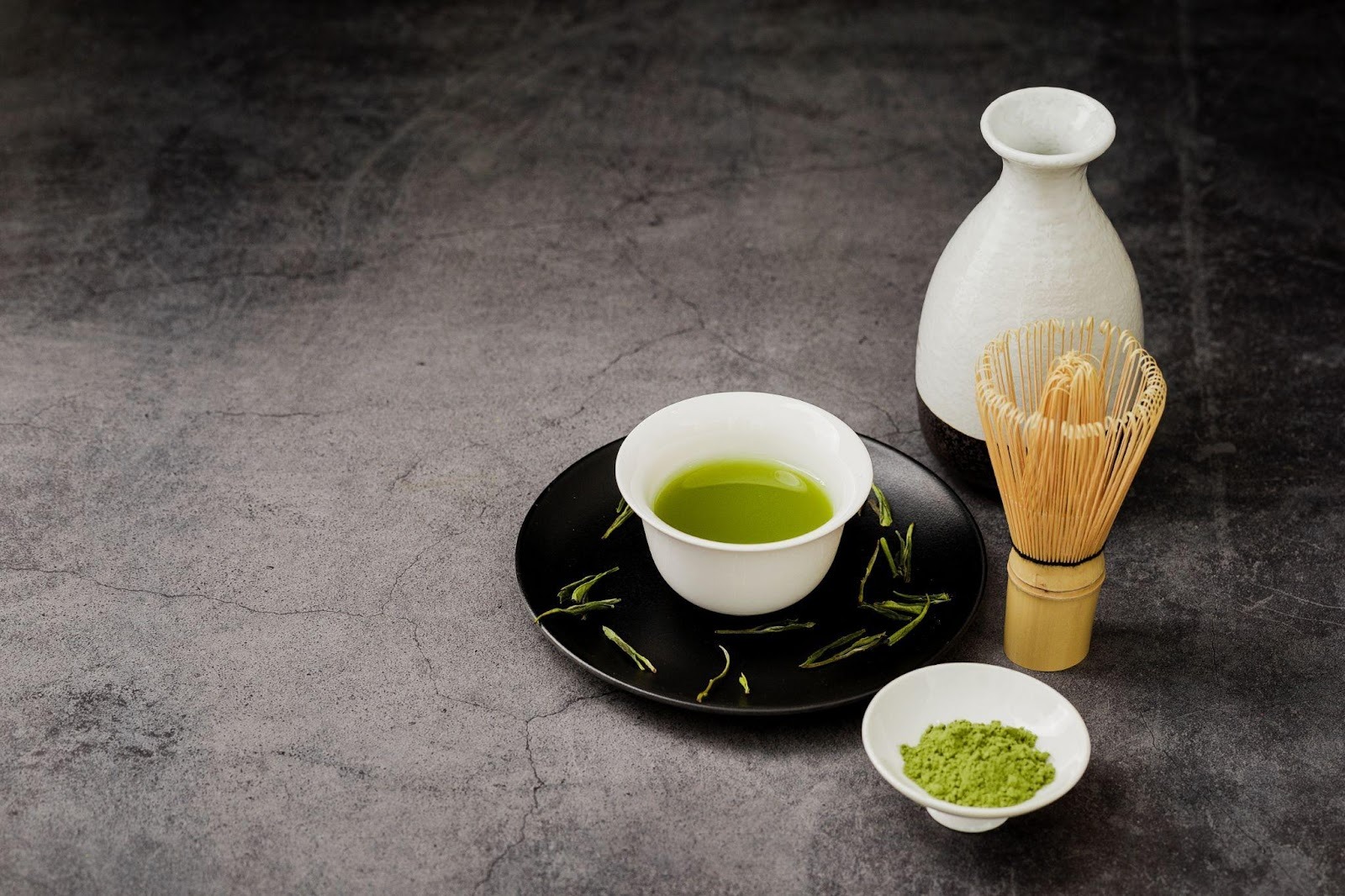
Green tea is a traditional beverage made from the leaves of Camellia sinensis. It is widely consumed in many parts of the world.
Chinese and Japanese green teas differ mainly in processing methods and cultural practices.
Matcha is a distinct type of Japanese green tea, which is characterised by its unique cultivation and preparation methods.
Unlike most green teas, matcha does not undergo fermentation, and the leaves are shade-grown, steamed, and ground into a fine powder rather than brewed.
This processing method gives matcha its bright green colour and concentrated flavour.
Matcha Production
Matcha is available in various forms, including dried whole leaves, tea bags, and powdered forms.
To produce premium-quality leaves, tea plants are grown in a controlled environment with bamboo mats to protect them from direct sunlight. There are several steps involved in the production of matcha:
- Step 1: Young tea leaves are picked during harvesting.
- Step 2: The leaves are promptly steamed to prevent oxidation
- Step 3: The unwanted parts of leaves, including stems and veins, are removed to give a strong green colour and non-bitter taste.
- Step 4: Leaves are crushed into a smooth powder in a grinding device.
- Step 5: The powder needs to be mixed with water that is between 70 and 80°C to bring out the flavour of matcha and ensure its creaminess and frothiness.
Matcha Grades
Before discussing nutrition, health, and culinary uses, it is important to distinguish between matcha grades.
| Ceremonial grade | Culinary grade | |
| Quality | Highest | Lower |
| Uses | Cultural ceremony | Recipes |
| Leaves | Young leaves with buds | Leaves beyond the first, which look bigger and mature |
| Grinding | Slower and steadier speed | Faster and inconsistent |
| Colour | Bright green | Yellowish-green |
| Taste | Sweet | Bitter |
| Cost | Higher | Lower |
Differences between ceremonial and culinary grade matcha.
Nutritional Composition
Matcha is composed of 60 to 70 per cent insoluble components and 30 to 40 per cent soluble components.
Findings have discovered features that contribute to the uniqueness of matcha in comparison to other beverages.
As matcha tea leaves are shaded for the majority of the growth period, they have a lower level of catechin, a group of antioxidant compounds that help reduce oxidative stress, than other types of green tea that are exposed directly to the sunlight.
Surprisingly, when matcha is dissolved in water, it releases up to three times more catechins than in other green teas.
Moreover, young tea leaves with undeveloped shoots contain more caffeine than fully developed leaves and coffee beans. Its high levels of amino acids also result in the signature ‘umami’ flavour.
Matcha is also a source of plant protein, healthy fat, rutin, quercetin, and Vitamin C compared to other green teas.
| Per 100g | ||
| Insoluble components (60-70%) | Insoluble dietary fibers | 52.8g |
| Proteins | 17.3g | |
| Fat-soluble vitamins | 7.285g | |
| Soluble components(30-40%) | Soluble dietary fibers | 3.3g |
| Caffeine | 0.002g | |
| Water-soluble vitamins | 0.19g | |
Nutrition composition of matcha.
Health Benefits And Risks
Matcha offers several health benefits when consumed in moderation of one to three cups.
Its antioxidant may reduce DNA damage and lower the risk of progressive neurological diseases. It has also been shown to improve the lipid profile by suppressing cholesterol production and promoting the removal of LDL (bad) cholesterol from the bloodstream.
Furthermore, matcha may prevent cancer cells from growing uncontrollably, particularly in patients undergoing cancer treatment. It also enhances alertness while promoting calmness and concentration, making it beneficial in high-stress environments.

Health benefits of matcha.
Findings have shown that matcha is not suitable for everyone. Individuals with heart disease should avoid caffeine due to its caffeine content, which may lead to irregular heart rhythms.
Pregnant and breastfeeding women should limit intake to one or two cups per day. On top of that, individuals who are highly sensitive to caffeine may experience insomnia.
Matcha also inhibits iron absorption and is not recommended for individuals with anemia or iron deficiency. Besides that, patients with renal failure should avoid matcha.
Tea plants naturally absorb aluminium from the soil, and because matcha involves consuming the entire tea leaf, aluminium intake may be higher.
This leads to a buildup of aluminium in the body, making it more difficult for the kidneys to remove unwanted substances.
Many consumers are unaware of the added sugar in beverages. For example, maple syrup, which contains about 65 per cent of the sugar found in table sugar, can increase the likelihood of cardiac disease, type 2 diabetes, and being overweight.
Similarly, sorbitol is commonly used and is often claimed to have no calories. Nevertheless, consuming as little as 5 grams can increase gas, while intake of 20 grams may result in severe symptoms like diarrhoea.
These sweeteners can also result in tooth cavities, leading to poor oral health.
In a nutshell, matcha remains a popular trend for more than just its health benefits. However, the continued popularity is largely driven by lifestyle trends, social media influence, and product marketing.
In many cases, added sugar and flavourings reduce its health value, and consumers may focus more on taste and appearance than nutrition.
While matcha can be a healthy choice when consumed in its pure form and in moderation, it is not keeping its trend mainly because of its health benefits.
Yap Rou En is a Master’s programme student in clinical nutrition, Universiti Kebangsaan Malaysia, and Dr You Yee Xing is a senior lecturer in dietetics, Universiti Kebangsaan Malaysia.
- This is the personal opinion of the writer or publication and does not necessarily represent the views of Ova.