
KUALA LUMPUR, Dec 10 – “Who are Malaysia’s nation builders?” When asked this question, typically you may think of leaders who paved the path for our independence, or perhaps notable (majority male) Prime Ministers, politicians, and policymakers Malaysia has had over our 61-year history as a country.
However, nation builders are not limited to the realms of politics and governance alone, they come in all shapes and forms across a variety of sectors: from health, education, law and order, defence, business and finance, science, culture, and more.
A nation builder is someone who contributes to fostering social cohesion, socioeconomic health and prosperity, and political stability.
Their work and actions shape the direction and development of our country.
And as the minds and hands which mould our country’s future and collective destiny, the importance of these individuals cannot be understated.
It is thus essential that women are equally represented as leaders and nation builders, as this ensures the voices and needs of 50 per cent of the country’s population are equitably represented in national development.
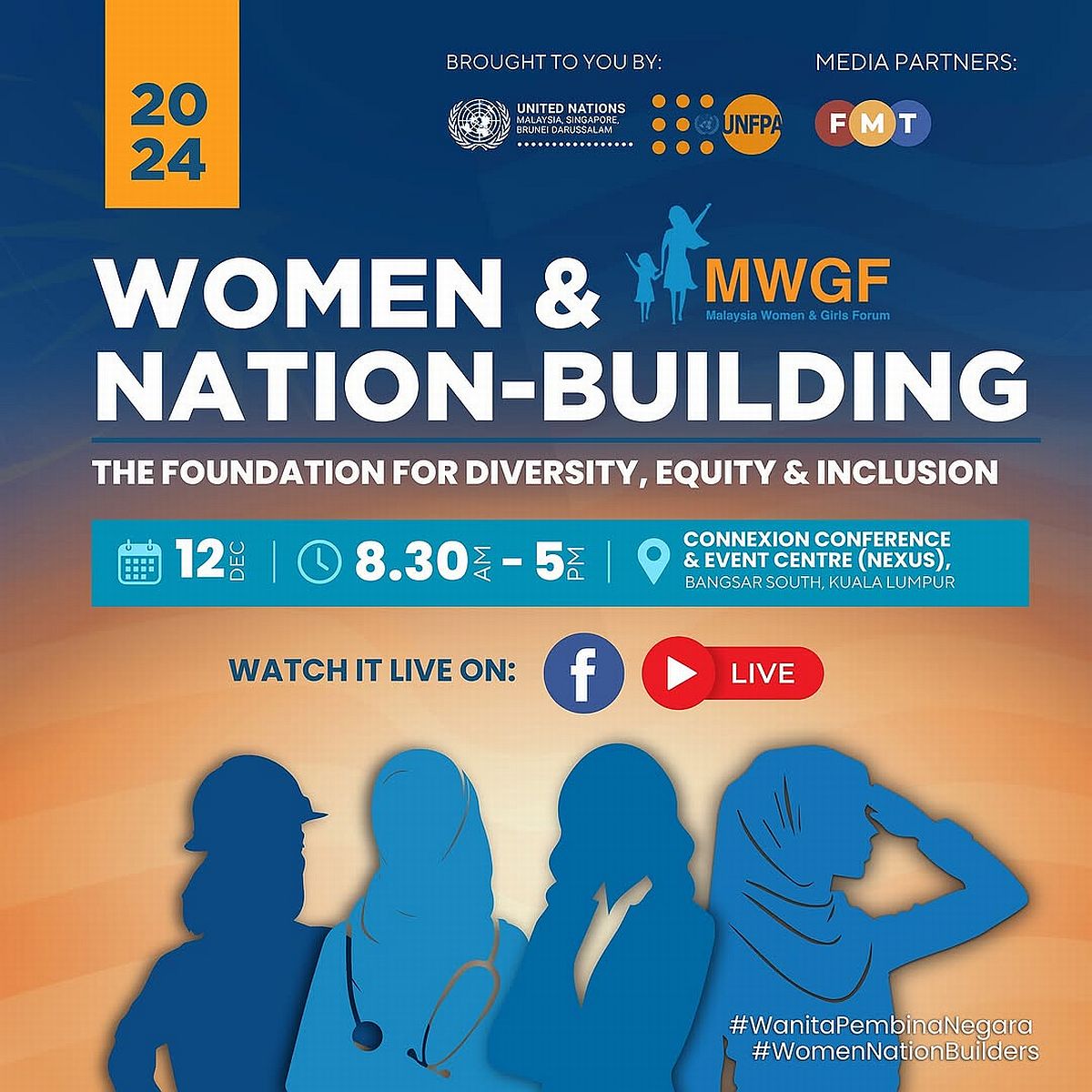
To further explore and amplify the importance of gender equity in public life, this year’s edition of the Malaysia Women and Girls Forum (MWGF) (and the fourth since its conception in 2020) brought to you by the United Nations and UNFPA Malaysia is themed “Women and Nation Building: The Foundation for Diversity, Equity and Inclusion”.
It will be held on December 12 at Connexion Conference and Convention Centre (Nexus) and livestreamed to the public via Facebook and YouTube.
Speakers and panellists will include Nancy Shukri, Minister of Women, Family and Community Development, Fadhlina Sidek, Minister of Education, Teo Nie Ching, Deputy Minister of Communications, Latheefa Kota of Lawyers for Liberty, and many more.
Women’s Nation Building Equity In Malaysia
At present, we have yet to attain equal gender representation and empowerment. There are still significant gender gaps in many areas, from participation in politics and public life, to gaps in economic participation, remuneration and opportunity.
It is critical to address these gaps urgently, as it deeply affects the wellbeing of women and girls, as well as all Malaysians.
When women are not represented equally in public life or are economically disadvantaged, our country loses out in untapped economic might, untapped talent and human potential that is critical, especially now as the world grapples with new and dynamic challenges spanning climate change, shifts in populations dynamics, sweeping technological advances and the rise of global political instability and conflicts.
Currently, Malaysia ranks 114 out of 146 countries on the World Economic Forum’s Gender Gap Index (GGGI).
Although Malaysia has successfully attained gender parity for Educational Attainment (1.000) and Healthcare (0.969), considerable gaps exist in Women’s Economic Empowerment and Opportunity (0.634) and Political Empowerment (0.068) in particular.
To further illustrate the gender gap in economic opportunity, the Department of Statistics Malaysia (DOSM) recorded a Labour Force Participation Rate (LFPR) of only 55.8 per cent for women, as compared to 81.9 per cent for men.
The gender wage gap, on the other hand, stands at 33.3 per cent, with women receiving only RM66.67 for every RM100 in salaries and wages received by men.
Additionally, although women make up roughly 50 per cent of the nation’s population, Malaysia’s political and decision-making spheres are still primarily dominated by men. There has been progress in representation across the years, but it is slow going.
As far back as 2004, the Malaysian government set a 30 per cent target for female representation as decision makers in the public sector. Yet, 20 years later, this is far from the reality.
For context, in the civil service currently, there are only two female Secretary-Generals. Female Members of Parliament entail 13.5 per cent of the Dewan Rakyat, while female ministers constitute 16.1 per cent of the Cabinet.
In Malaysia’s entire history, the sobering reality is that we have never exceeded five female ministers at one time in any Cabinet.
With such scant female representation in our highest echelons of public leadership and policy making, what does this say about our value for women’s wellbeing and contributions as a nation?
How can we truly be an inclusive, democratic nation if women’s voices are barely present in our corridors of power and decision making?
For the sake of our collective future, it is incumbent on us to identify and address the barriers that keep women out of leadership and public life.
Some of these barriers include harmful social norms, discrimination and enduring gender stereotypes about the role of women in society, what they ‘can’ or ‘cannot’ do.
Others include the prevalence and normalisation of violence against women, both online and in real life domains such as the domestic sphere, educational institutions and workplaces, that discourages women from participating in public spaces and limits their political representation.
The lack of access to sexual and reproductive health (SRH) services and Comprehensive Sexuality Education (CSE) also contributes to unwanted pregnancies that can further blunt women’s socio-economic prospects, an issue compounded by society’s lack of support for family-friendly policies, and the disproportionate burden of Unpaid Care Work (UCW) majority shouldered by women.
We have so much to gain from removing these barriers that limit women’s socio economic and political participation, from increases in the national GDP and realisation of the full economic potential of both our men and women, to elevating Malaysia into high-income nation status.
Research has also shown that female legislators have a positive impact on the breadth of policy priorities, as they emphasise the importance of social care and development indicators such as health and education, leading to more caring, inclusive, and sustainable societies.
MWGF 2024 aims to shed light on the critical role that Malaysia’s women and girls play in our country’s overall socioeconomic development, and discuss in depth barriers that continue to limit the potential and contribution of half our country’s population.
Through a series of thoughtful panel discussions featuring some of Malaysia’s own female ministers and nation-builders, policymakers, academics, youth and civil society representatives and activists, MWGF aims to provide Malaysians with a glimpse of what a gender equal future can look like, outline the solutions required to achieve it and reiterate how this is absolutely essential for our national development as we progress towards the 2030 Sustainable Development Goals.
In every edition since 2020, MWGF has served as a platform for the galvanisation of connections and collaborations between key stakeholders to advance the rights and wellbeing of Malaysia’s women and girls.
With this year’s theme, the focus is actionably addressing women’s socioeconomic parity and representation, and setting the tone for gender-inclusive policy making as we enter a new year – one where Malaysia takes on a pivotal role as ASEAN Chair in 2025.
This year, join us live on the 12th of December via our Facebook event page. For further programme and speaker details, please visit the MWGF website.