

KUALA LUMPUR, July 31 — She is a Malaysian citizen, a daughter, a student, a worker and a woman living with a disability.
Yet, when she goes to apply for financial aid, to register for skills training, or even to seek safe public transport, the doors remain half-closed.
“They ask us to be independent,” one participant shared during a recent national study, “but they forget that independence is not given–it is enabled.”
Her story is not unique. It is echoed by thousands of other women and individuals with disabilities who find themselves navigating a system that still does not see them, even as the country speaks of progress.
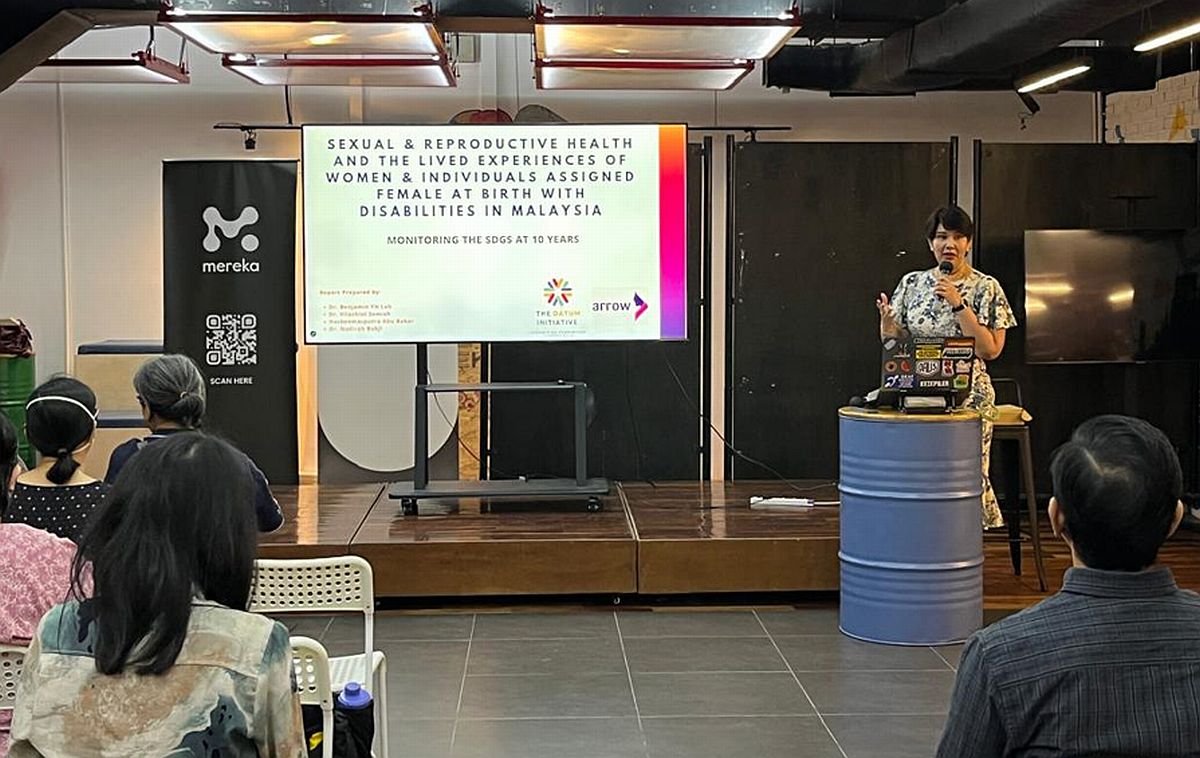
This reality is the focus of a new “National Report on Monitoring the SDGs at 10 Years: Sexual and Reproductive Health and the Lived Experiences of Women and Individuals Assigned Female at Birth with Disabilities in Malaysia”, launched yesterday at Mereka Space, Kuala Lumpur.
This report investigates the structural, legal, and lived realities surrounding the sexual and reproductive health and rights (SRHR) of disabled women and individuals assigned female at birth in Malaysia.
The event, themed “Digital Inclusion and Women with Disabilities”, is organised by the Datum Initiative, the Asian-Pacific Resource and Research Centre for Women (ARROW), and the Southeast Asia Research Centre for Digital Tech and Society (SEADS) at Monash University Malaysia.
It emerges from a collaborative research effort between the Datum Initiative and ARROW, focusing on the lived experiences of women and girls with disabilities in Malaysia.
It seeks to document and analyse the structural, social, and institutional barriers they face, particularly around sexual and reproductive health and rights (SRHR), healthcare access, education, and social stigma.
Dr Vilashini Somiah, co-founder of the Datum Initiative and a senior lecturer attached to Universiti Malaya’s Gender Studies Programme, said in her opening speech: “Datum was born from a shared belief that data, even in its smallest form, a single datum, holds power.
“When gathered and handled with care, data becomes a collective force for structural change. At Datum, we work to equip civil society organisations and communities across Malaysia with the skills to manage, protect, and mobilise their data not just to speak truth to power, but to influence policy, demand rights, and reshape the systems that exclude.
“This report forms part of ARROW’s larger regional initiative. It is a report grounded in care, stitched together with the voices of persons with disabilities who spoke bravely and honestly about their experiences of medical neglect, institutional abandonment, and everyday resilience.”
The researchers and authors of the report are Dr Vilashini, Dr Benjamin Loh, Hasbeemasputra Abu Bakar, and Dr Nadirah Babji. Their collective expertise combines digital ethnography, feminist anthropology, disability rights advocacy, and public health.
The full official report is set to be released to the public by the end of August 2025.
The report examines how far Malaysia has come ten years into the Sustainable Development Goals in fulfilling its commitments to ensure that no one is left behind.
Through interviews and participatory research, it reveals deep systemic gaps in services, access, and dignity for persons with disabilities, particularly for women and assigned female at birth (AFAB) individuals, whose needs are often sidelined in national planning.
“[It is not a disability when I am unable to hear through my ear, it becomes a disability only when I am not permitted access to hearing aids so I may be able to hear”, stated Hasbee, a co-researcher and disability rights advocate.
The irony is stark. Malaysia is positioning itself to become a high-income nation within the next couple of years. It ratified the United Nations Convention on the Rights of Persons with Disabilities (CRPD) in 2010, promising to protect and promote equal rights.
And yet, lived experiences from the ground paint a sobering picture: of the country’s population, an estimated 16 per cent are persons with disabilities, and far too many continue to be excluded from justice, education, health care, digital access, and basic accommodation that would allow them to participate fully in society.
In addition to the report launch, the event featured a dynamic panel discussion on how digital technologies can be a bridge rather than a barrier.
The session, titled “Digital Inclusion and Women with Disabilities,” explored how disabled people, though often left out of institutional systems, have found empowerment through digital tools that provide both accessibility and a sense of community.
The panellists consisted of Adhura Farouk, a disabled economist and Boleh Space representative, Beatrice Leong, a disabled filmmaker and Autism Inclusiveness Direct Action Group (AIDA) founder, and Dr Loh, co-founder of the Datum Initiative and Monash University Malaysia lecturer.
The session was moderated by Farhana Abdul Fatah, a lecturer from Universiti Malaya’s Gender Studies programme.
“I like to use the term ‘pre-disabled’,” said Adhura, “because the truth is, every single one of us carries the risk of becoming disabled one day.
“Disability is not something that happens to ‘other people’, it is a shared human vulnerability.
“When we start from that understanding, inclusion stops being charity and becomes justice.”
This collaborative event aimed to shift the conversation from promises on paper to real changes in practice.
As the discussions concluded, one question lingered in the room: What does it mean for a country to call itself ‘developed’ if its most marginalised citizens are still fighting to be seen?