
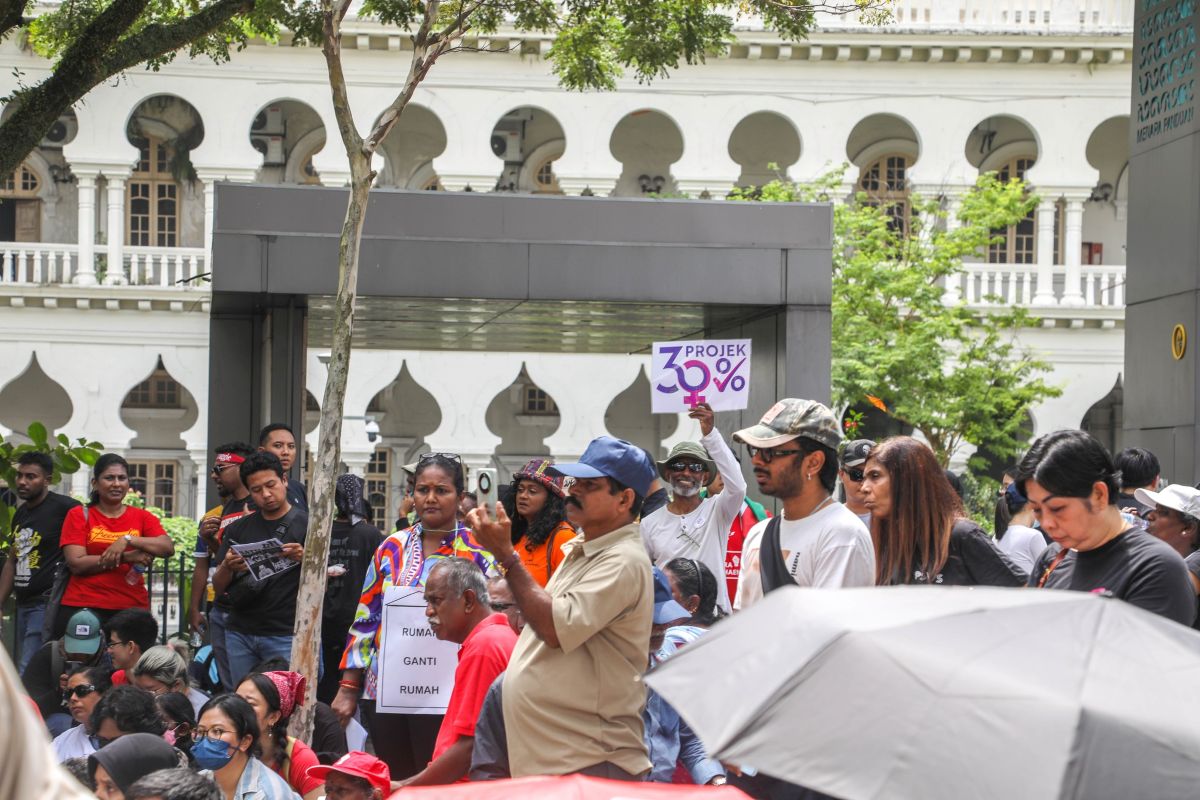
Persatuan Kesedaran Komuniti Selangor or Empower, a small feminist NGO fighting for gender equality, was honoured to be part of the 2025 May Day Rally in downtown Kuala Lumpur organised by Jawatankuasa May Day 2025 (JMD2025).
We celebrate the dignity and struggles of working people in this country, and the world.
Yet, here we are today knowing that working people do not get a fair share of the wealth they create.
The median monthly salary in the formal sector is RM2,745 (DOSM, 2Q/2024). That means half of all salaried people in Malaysia get no more than this!
This is barely a living wage.
Therefore, we fully endorse the Deklarasi 1 May 2025 issued by the JMD2025.
Women Mostly Occupy Feminised Roles
Let’s jump straight into the situation of women workers and employees. Women and girls make up half our population.
Our labour force adds up to 17.2 million workers made up of 10.5 million male workers and 6.7 million female workers (DOSM, July 2024). The imbalance is pretty clear.
The female labour force participation rate (LFPR) is only 56.7 per cent compared to men at 83.3 per cent making the overall LFPR 70.4 per cent (DOSM, July 2024).
That means 43.3 per cent of women who are available to work, don’t. This is such a stark contrast with the male LFPR points to structural and social barriers to women working.
Whilst women are well represented in schools, colleges or universities, they are under-represented in vocational education especially in technical and scientific fields because of patriarchal thinking and gender stereotyping.
Women for the most part occupy feminised roles.
Note also the gender pay gap. According to Khazanah Research Institute (Oct 2024) women receive on average 18 per cent less wages overall compared to their male counterparts after adjusting for age, occupation, skills, education, states, and sectors.
Behind this gender pay gap is gender discrimination in the labour market.
Then, there are the workers outside the labour force, which comprises 7.2 million persons (DOSM, July 2024).
Out of this number, 42.8 per cent cite housework and family responsibilities and 41.4 per cent cite schooling or training as reasons for staying out of the labour force.
Almost all of the 42.8 per cent engaged in housework or family duties are women (about 3 million) whose unpaid contributions remain invisible in our political and economic systems.
This unaccounted “care” labour in the home reproduces not only the family but
also the male worker day-in-day-out.
Daily Aggressions And Micro-Aggressions
Then let’s examine the aggressions and micro-aggressions that women undergo in their daily lives.
The table below summarises the reported cases of gender-based violence from 2021 through to 2023 (DOSM Crime Statistics 2024).

Note that the above are reported cases collected by DOSM from the Royal Malaysian Police (PDRM). Many cases go unreported.
Note that marital rape is not a crime here.
Stalking was criminalised in 2023 in the Penal Code (Section 507A) and the RMP reported 50 cases between 2023-2024.
Second Last In Asean In Terms Of Women’s Representation
So, we have women for the most part in feminised roles, low pay, low LFPR, subject to GBV and all sorts of micro-aggressions in a patriarchal society.
How can we effect real change? The answer is political power.
But women’s representation here is poor. Thirty years after Beijing 1995, there are only 13.5 per cent women MPs, 12.2 per cent state assembly women, and 19.7 per cent women local councillors.
Women’s voices in these corridors of power are not heard and often mocked.
Plans and manifestos have previously been put out about raising women’s representation in these fora to 30 pe cent (2009 Pelan Tindakan Pembangunan
Wanita, 2017 PH Manifesto, etc) but not delivered.
We are second last in Asean in terms of women’s representation.
There’s an immediate need for political parties to field at least 30 per cent women candidates at all levels and to also amend the electoral laws to require all political parties to field at least 30 per cent women by GE16 (16th general elections).
This is Empower’s Projek30% Campaign supported by JAG (Joint Action Group for Gender Equality, Bersih (The Coalition for Clean and Fair Elections) and CSOP4R (The CSO Platform for Reform).
This will result in a more representative voice and hopefully deliver the critical mass of at least 30 per cent women by GE16.
Then perhaps change towards gender equality can be accelerated especially for women workers!
- This is the personal opinion of the writer or publication and does not necessarily represent the views of Ova.