
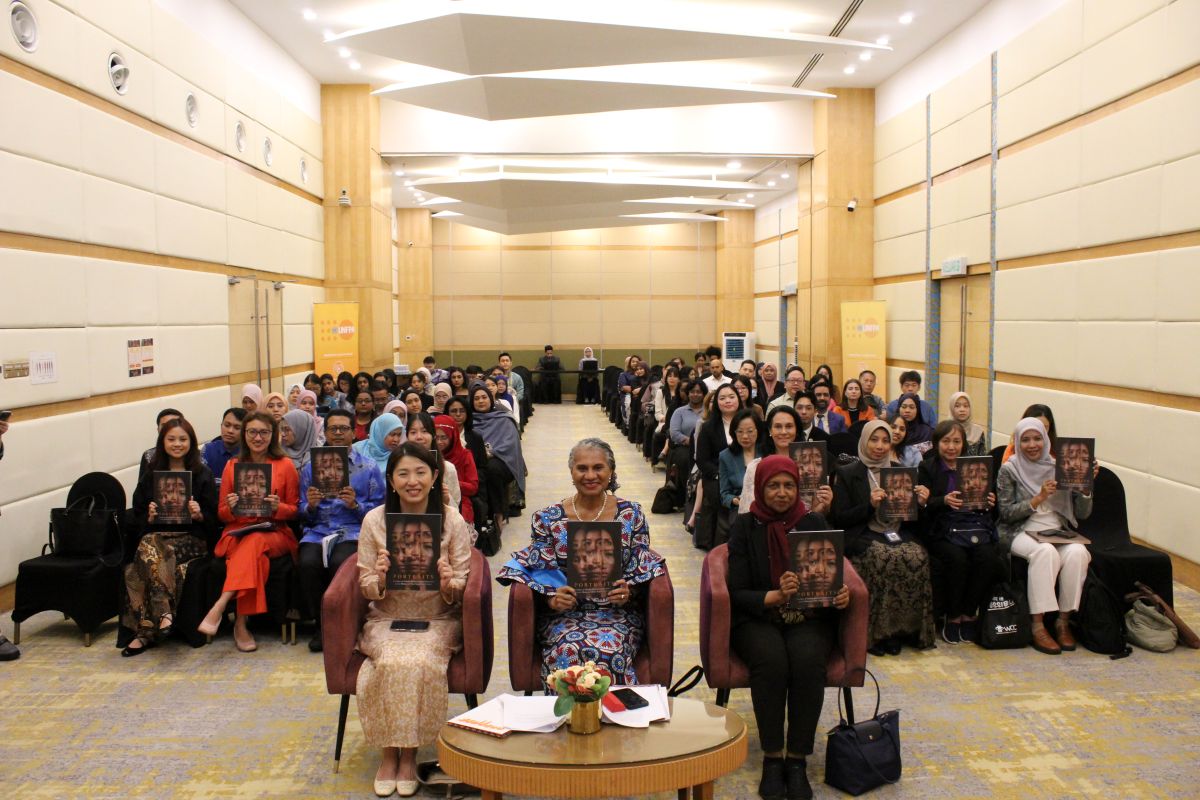
PUTRAJAYA, March 7 – The United Nations Population Fund (UNFPA) Malaysia and the United Nations International Institute for Global Health (UNU-IIGH) hosted a report dissemination event yesterday of their joint publication titled“Portraits: Journeys of Gender-Based Violence Survivors across Malaysia’s One Stop Crisis Centres”.
The report documents the experiences of gender-based violence (GBV) survivors at one-stop crisis centres (OSCCs) across public hospitals in Malaysia with the aim of bridging the gap between policy intentions and service delivery outcomes.
First launched at the Kuala Lumpur General Hospital in 1994, OSCCs were designed and integrated within the health system to provide round-the-clock comprehensive and coordinated services to GBV survivors, from health-related services such as medical examinations and physical and psychological treatments, to non-health services such as police and legal support, social support, and referrals to shelter homes.
UNFPA and UNU-IIGH’s joint report examines the gaps and strengths in Malaysia’s OSCC service delivery, drawing on in-depth interviews with GBV survivors and key civil society stakeholders in the field.
Through the development of detailed ‘personas’ synthesising the experiences of a range of GBV survivors, primarily women from different ethnicities and backgrounds, the report traces survivors’ journeys through the OSCC system, highlighting the structural and societal barriers they face while identifying potential areas for GBV response improvement.
The report concludes with a strong recommendation for comprehensive policy reforms and improvements in both national legal and health care frameworks to better address GBV in Malaysia, and ensure a safer, more supportive environment for all individuals, regardless of their background.
GBV Survivors Come In Any Shape And Size, From All Walks Of Life

In her welcome address, Dr Julitta Onabanjo, UNFPA country representative for Malaysia, said that GBV survivors come in any shape and size, but share in common the need for understanding, care and a safe space to help them heal from their ordeal.
“They can be young or old, female or male, rich or poor, Malaysian or foreigner, married or not, highly educated or not.
Some may have the language to describe their harrowing experience, some may not. Whoever they are, survivors need to feel safe to tell their stories,” she said.
“They need a trusting space where they will be understood and not judged. They need to know they will be believed and not stigmatised. They need to know they can be trusted and they can trust those who are responsible for giving them care.”
She called for attention to the report’s findings and recommendations to further enhance the OSCC model.
“By centring the lived experiences of survivors, the findings and recommendations of this report provide an important reference point for enhancing One-Stop Crisis Centres.”
Improving Infrastructure, Process, Procedures Will Change Lives
In her keynote address, chairwoman of the Parliament Special Select Committee for Women, Children and Community Development, Yeo Bee Yin provided an example of a case that demonstrates how a gap in the system may exacerbate the trauma experienced by a GBV survivor.
On a visit to an OSCC, Yeo, who is also Puchong MP, was informed about a case where a victim from either Kedah or Kelantan who was fleeing her abuser travelled all the way to the OSCC in Putrajaya.
“At the Putrajaya OSCC, the police told her, you need to go back to the state,” said Yeo, adding that it was because she had crossed jurisdictions. Eventually, the investigating office (IO) was asked to come to the hospital.
“If we can actually make infrastructure, the process, the procedures better, it is going to change lives,” Yeo said. “The lives that we change are those that most need it.”
She said that improving the OSCCs is something that involves the government, private sector, social workers, the grassroots, and members of the public and wider society.
Women’s Issues Are Not Just Social Issues, Also Affect Economic Growth

In her keynote, Yeo also called for wider acknowledgment of issues that are important to women, pointing out that their significance is often underestimated.
“For example, we think education is important, we think child care is important, we think gender-based violence is important,” she said, adding that those issues are not just social issues, but also affect the economic growth of the country.
“Gender-based violence will affect our GDP. The same goes for women returning to work, better child care, social work – all of this matters to the economy of this country.
“If we can have a more inclusive society that cares for every generation, I think our economy will do better.”
Malaysia Must Take The Lead To End GBV
At the conclusion of her speech, Dr Onabanjo said that Malaysia’s commitment, leadership, and efforts to combat gender-based violence is pivotal on the 30-year anniversary of the Beijing Declaration and Platform for Action.
The Beijing Declaration and Platform of Action, which was adopted by consensus in 1995 at the Fourth World Conference on Women in Beijing, China, describes the commitment of the international community to achieve gender equality and to provide better opportunities for women and girls.
“I think Malaysia’s role as the 2025 ASEAN Chair, as well as the one-year follow-up to Malaysia’s sixth periodic report to Cedaw (Committee on the Elimination of Discrimination against Women) – these are all opportunities for Malaysia again to show its commitment and its conviction to ending gender-based violence.”