
KUALA LUMPUR, June 10 – “I feel even if I tell, nobody understands. So why even bother telling? I (will) just silence the issue. I don’t plan to get married because of this disease.”
In a presentation during a scientific workshop on endometriosis organised by Thomson Fertility, Evodie Paul, a physiotherapist from France, shared that this was one of the responses she got when she interviewed an endometriosis patient.
The patient’s sentiments may well represent the larger population of endometriosis patients, who suffer from debilitating pain because of the disease, but often have their pain disregarded because its effects, which include severe pain during menstruation, sex, urination, and defecation, as well as infertility, are not apparent to the naked eye.
“Endometriosis is an enigmatic disease. Many women live through cycles of pain, ineffective medication, and repeat surgeries due to delayed or inadequate treatment,” said Dr J. Ravichandan, senior consultant obstetrician and gynaecologist and maternal foetal medical consultant at Hospital Sultanah Aminah, Johor Baru.
“There is an urgent need for better data and early intervention strategies to optimise care.”
Gender Pain Gap
The aura of mystery that surrounds the disease is exacerbated by the lack of research about it, which can also be attributed to the gender pain gap.
The gender pain gap refers to the discrimination women face when seeking medical assistance, which results in their ailments and pain being dismissed, invalidated, poorly managed, and misdiagnosed.
“Due to the gender pay gap and no clinically usable biomarkers, and previously diagnostic laparoscopy as the gold standard, studies have found that it takes six to 12 years for women to be diagnosed with endometriosis,” said Dr Hannah Nazri, National Institute for Health and Care Academic Clinical Fellow in Obstetrics and Gynaecology at the University of Warwick.
Doctors who are unfamiliar with the endometriosis, or baffled by its impact on patients who exhibit no telltale signs of the disease, may be dismissive of their woes and sufferings.
Paul also shared the response of another patient about their relationship with doctors. The patient said: “My doctor, he definitely didn’t trust me. (He said) oh, you are just too sensitive to pain.”
While endometriosis is characterised by tissue that is similar to the ones lining the uterus, also growing outside of it–which can cause inflammation and the formation of scar tissues–the most typical feature of the disease for the person suffering from it, is the debilitating pain they feel.
Types Of Chronic Pain
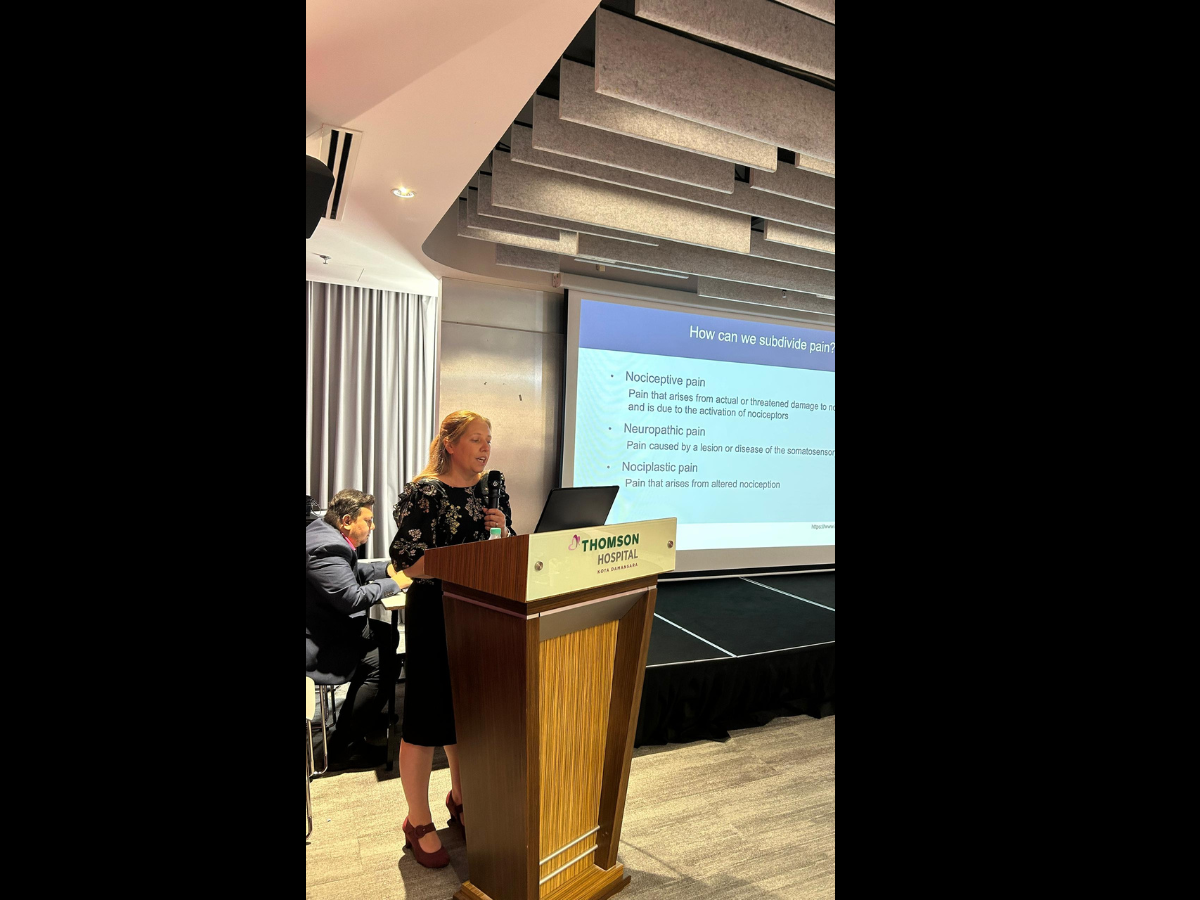
During the workshop, Prof Katy Vincent, senior fellow in Pain in Women at Oxford University gave a presentation on how endometriosis-associated pain has evolved in recent years due to a more modern understanding of the mechanisms underlying pain, and shared her insights on what a pain programme could encompass.
Vincent began by explaining the three different types of chronic pain.
Noniceptive pain is pain that arises from damaged tissue or inflammation. “It’s the type of pain that would happen if you put your hand on something hot, for example.”
Neuropathic pain is caused by damage to the somatosensory nervous system. The nerves in this system deliver information from the senses to the brain and also from the brain to the muscles, enabling movement.
Nociplastic pain arises from changes in the way that pain signals are sent to and interpreted by the nervous system despite no clear evidence of actual or threatened tissue damage or evidence for disease or lesion of the somatosensory system causing the pain.
A classical example of nociplastic pain is fibromyalgia, according to Prof Vincent. Fibromyalgia is a chronic and long-lasting disorder characterised by pain and tenderness throughout the body, and other symptoms such as fatigue, muscle stiffness and insomnia.
Pain Puzzle
The traditional model of endometriosis associated pain is nociceptive, with treatments that correspond to this type of pain, said Prof Vincent.
“They’re targeting the lesions themselves, either suppressing them with hormones or excising them with surgery.”
However, there is no evidence to suggest that endometriosis associated pain is actually nociceptive, she continued.
“Well, if we thought that it was, we would expect that the amount of disease that you saw at laparoscopy or on scanning, for example, would correlate with the amount of pain that you perceived. And we know that that’s not true.”
In fact, the relatively limited studies on endometriosis associated pain have not shown an association between disease stage or lesion location and the severity of types of pain that patients experience, according to Vincent.
“We know that if we take our traditional approaches to management, we’ll find that about 50 per cent of people will have some pain remaining with hormone therapy,” she continued.
“And it’s uncertain at the moment whether laparoscopic surgery reduces overall pain, particularly when you only have minimal disease.”
So, could endometriosis associated pain be neuropathic? “The answer to that is very definitely yes,” Prof Vincent said.
Based on an online survey and screening questionnaire with almost 1,500 women, 40 per cent of them met the criteria of having neuropathic pain.
“If we look specifically at the type of words that they would use for their pain, that was things like burning, pricking, pressure-evoked pain,” she explained.
“But we also saw numbness in 14 per cent. And numbness is a really classic presentation of a subgroup of neuropathic pain. So (that is) really validating that this is genuine neuropathic rather than just someone reporting more pain than they might do otherwise.”
She posited an alternative way of thinking about pain, namely pain that’s much more related to the way that pain signals are sent and interpreted.
“We know that by the time they get a diagnosis for endometriosis, all of our patients will have had pain for far longer than three months, unless it’s an asymptomatic presentation, for example,” Vincent said.
Pain outside the pelvis is common with endometriosis, she continued, adding that many patients in a study she conducted suffer from pelvic comorbidities like irritable bowel syndrome, bladder pain syndrome, and vulva pain syndrome.
A huge proportion of the patients also described non-pelvic pain conditions like migraine, hematoid arthritis, and temporal mandibula joint dysfunction.
But it is the patients with endometriosis and pelvic pain that really exhibit changes in brain signalling, according to Vincent.
“And if we go onto social media, there’s a lot of chat about brain fog, about fatigue, about the sort of much wider systemic implications that endometriosis can have for our patients.
“So I think we’re kind of within the boundaries of being able to say that yes, we do meet these criteria for nociplastic pain for a significant proportion of our patients.”
The Less Travelled Road Of Adenomyosis

When it comes to adenomyosis, Vincent said even less is known about what causes the pain that comes with the disease because it has been considerably less explored than endometriosis.
While endometrial-like cells grow outside the uterus for patients suffering from endometriosis, in the case of adenomyosis, endometrial-like cells grow within the muscles of the uterus.
Patients with adenomyosis may also suffer from dysmenorrhea (painful periods), dyspareunia (painful sexual intercourse), chronic pelvic pain, and infertility, although some women with adenomyosis do not have any pain.
“I think it’s very important to remember that adenomyosis is stuck within the uterus. So it’s very much a visceral condition. And viscera, our hollow organs, have a very different pain-sensing system from our somatic nervous system,” said Vincent.
“And visceral pain we know is by its very nature diffused, poorly localised, and refers elsewhere. It is also associated with symptoms like nausea and vomiting, for example, which is a very classic description of dysmenorrhea particularly, especially in younger patients.”
Pain Education And Chronic Pain Management
A holistic pain programme should include management of the endometriosis and the adenomyosis, as well as management of any comorbidities, including painful comorbidities or inflammatory comorbidities, said Vincent, who is also an honorary consultant gynaecologist. It should incorporate medical therapy that targets those pain processes.
She added that it should also be combined with pain education, lifestyle medicine, flare management, and some sort of alternative or holistic medical type approaches, such as physiotherapy and pain psychology.
“Pain education is a key component of all chronic pain management. So we would always run pain education sessions for a chronic pain management programme,” Vincent said.
“But it’s actually missing from the majority of the chronic pelvic pain guidance around the world and it’s wanted by women.”
While pain education can be delivered by a clinician during an appointment, Vincent said it can be quite time consuming to explain the neurobiology and widespread implications of pain.
“It really takes a good hour and most of us don’t have the capacity to do that in a clinical consultation.”
She suggested that pain education can be delivered in groups, whether in person or online, adding that patients often really like this method “because it makes them realise that they’re not alone, that there are lots of other people who are experiencing the same symptoms and you can hear what other people ask and what might feel relevant to you too.”
Lifestyle Alterations To Better Manage Pain
Many of the different factors that can amplify or reduce pain can be altered by our lifestyle.
“So things like sleep, we only need to deprive someone of sleep for one whole night to make them as sensitive to pain as someone with chronic pain,” Vincent explained.
“Fatigue in itself can play a massive role in worsening our ability to cope with pain, but also in actually amplifying the pain signals that are sent to our brain.”
Diet and eating patterns can also influence bowel symptoms, Vincent continued, adding that there’s increasing evidence that the microbiome and bowel can have an impact on mood and fatigue as well.
“So there’s multiple ways by which these factors can feed off of one another. We know that stress massively amplifies pain, and that makes sense because our stress system is designed to be on a high alert at a time of danger, and therefore we should be aware of dangerous signals.”
According to a study she conducted, 76 per cent of patients with pelvic pain, some of whom had endometriosis, experienced flares.
“However, while the majority of patients were able to identify triggers for their flares, they weren’t putting in strategies to either prevent those triggers happening or to expect the pain coming afterwards.”
While flares may vary in length, pelvic pain classically affects the muscles of the abdominal wall, lower back, and the pelvic floor.
“Physiotherapy will aim both to build strength and body confidence because many people are really scared about getting back to exercising or moving because they know it flares their pain,” Vincent said.
However, with the right experts such as women’s health physiotherapists, targeted work on high tone pelvic floors in particular, can be incredibly beneficial with symptoms like dyspareunia, dysuria (painful or uncomfortable urination) and defecatory dysfunction, she added.
High-tone pelvic floor dysfunction is a neuromuscular disorder of the pelvic floor characterised by non-relaxing pelvic floor muscles, resulting in lower urinary tract and defecatory symptoms, sexual dysfunction, and pelvic pain.
Don’t Minimise The Pain That Patients Feel
While pain psychology is key to helping patients with chronic pain, Vincent said that it was important to emphasise why pain psychology is recommended to patients.
“It’s not because we don’t believe them or because we think the pain’s in their head, but because we know that our bodies and our minds aren’t separate.
“So the things that are going on in day-to-day life, as I’ve already mentioned, and in the way the brain is functioning, are going to impact on the experience of pain.”
She explained that pain psychology is different from mental health psychology. “Within pain psychology, we’re really thinking about thoughts and behaviours that are associated with pain and how we might be able to reduce both pain-related distress but also the interference of pain.
“If you can still manage to achieve all the valued activities that you want to, to achieve your life goals, even if you do still have some pain present, then actually we would consider that we have still made some benefit, even if we haven’t reduced the pain overall.”
She said that it was important not to minimise the pain that patients feel when delivering information about pain self-management and suggesting resources that can help with self-management.
“I think many of our patients have been dismissed a lot before they get seen and diagnosed with endometriosis.
“To then tell them to go and do a sleep programme and some yoga could feel like a really negative input. So this needs to come within the context of pain education so that people understand why they’re able to self-manage.”