

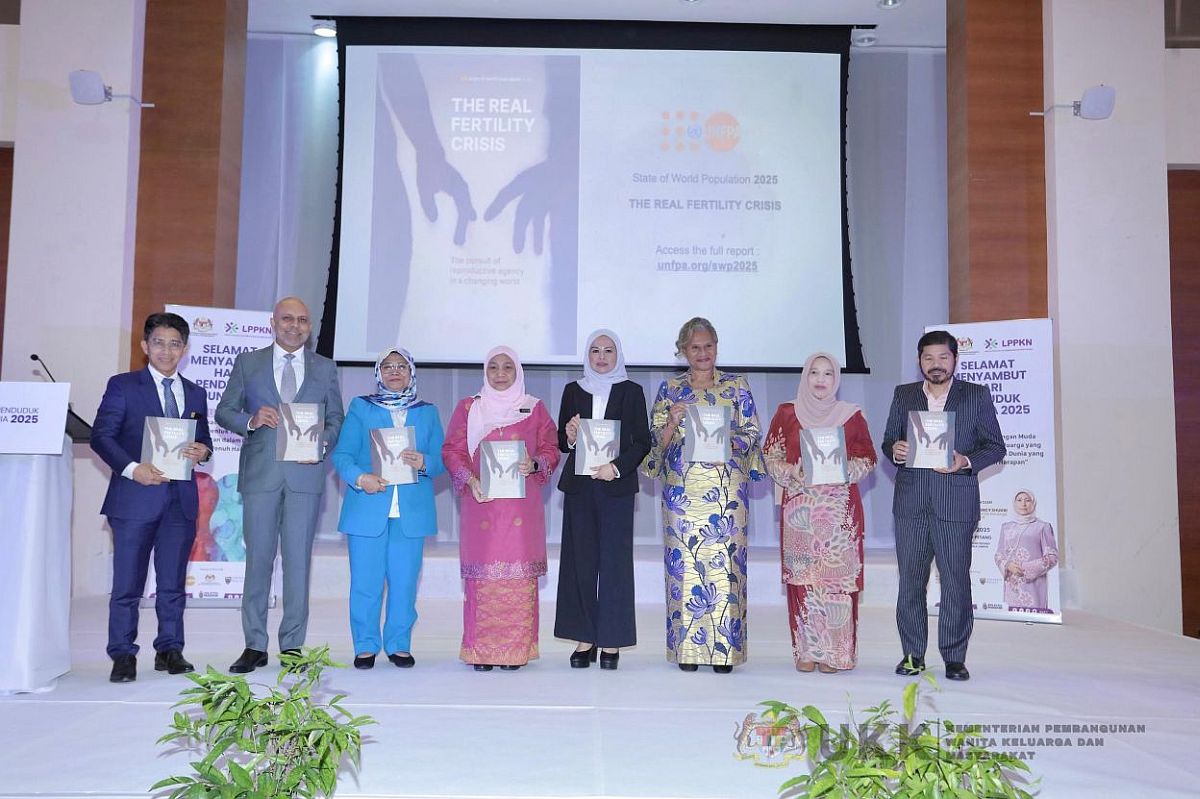
KUALA LUMPUR, July 22 – The National Population and Family Development Board (LPPKN) alongside the United Nations Population Fund (UNFPA) Malaysia, the Department of Statistics Malaysia (DOSM), and the Faculty of Business and Economics, University of Malaya (UM) recently commemorated World Population Day 2025 with a forum and report launch event at Lanai Kijang Bank Negara, Kuala Lumpur.
The event explored ways to navigate Malaysia’s current population challenges with a focus on the empowerment and reproductive agency of young people, in line with the global World Population Day theme “Empowering Young People to Create the Families They Want in a Fair and Hopeful World”.
Young people are often unfairly blamed for rejecting partnerships and parenthood, yet UNFPA research shows many would actually choose to have families and children, but are prevented from doing so by various barriers, including economic precarity, anxieties about the future and persistent gender inequality.
The event began with a forum moderated by Abdul Shukur Abdullah, LPPKN Director-General, featuring a distinguished panel of experts including Mohd Uzir Mahidin, DOSM Chief Statistician and Dr Vilashini Somiah, Senior Lecturer at the Gender Studies Programme at University of Malaya.
With the panel title “Addressing the Population Crisis: Towards a Sustainable and Inclusive Future”, the panellists unpacked challenges and opportunities in shaping Malaysia’s sustainable and equitable demographic future.
Topics discussed included the importance of universal access to sexual and reproductive health services, Comprehensive Sexuality Education (CSE), and life cycle approaches to enable healthy and dignified ageing, among others.
The panel was followed by a closing address delivered by Noraini Ahmad, Deputy Minister of Women. Family and Community Development on behalf of Nancy Shukri, Minister of Women, Family and Community Development, highlighting the barriers hampering young people from having families.
“One big question we often hear is – why is it that more and more young people are putting off marriage or choosing not to have families? Are they not interested?
“That is not the case. The reality is they still want to have families but they face increasingly challenging life pressures.
“Young people still want families — but they face real struggles: high living costs, low wages, student loans, unaffordable housing, and limited childcare options. These are not complaints — they are daily realities.” she said.
Finally, the event culminated in the Official Launch of the UNFPA State of World Population 2025 Report, titled “The Real Fertility Crisis: The Pursuit of Reproductive Agency in a Changing World”.
Based on a survey of 14 countries, the report elaborated on key issues concerning reproductive agency and its impact on family aspirations globally.
It argued that the real fertility crisis isn’t a failure to achieve arbitrary population or fertility targets, but rather the lack of reproductive agency — in other words, individuals’ ability to choose when, whether, and with whom to have a child.
The report launch keynote and presentation was delivered by Dr Julitta Onabanjo, UNFPA Country Representative for Malaysia.
“A central insight from the report survey is that regardless of a nation’s demographic context, be it high or low fertility, most people want two or more children and far too many people simply aren’t able to fulfil their fertility aspirations.
“Almost one in five (18 per cent) did not expect to achieve their desired family size. Most expect to have fewer children than they desire, some expect to have more.” she said.
“In every one of the 14 surveyed countries, the number one barrier hampering people from realising their family formation goals was economic. This represented more than half of the people surveyed.
“Two in five (39 per cent) said financial limitations had led them or are likely to lead them to have fewer children than desired.
“One in four (20 per cent) said job insecurity was a factor and one in four (19 per cent) cited housing limitations, like the lack of space and unaffordable high rental costs.” Onabanjo added.
The event saw active participation from attendees and media, contributing to a fruitful discussion on vital population issues.